




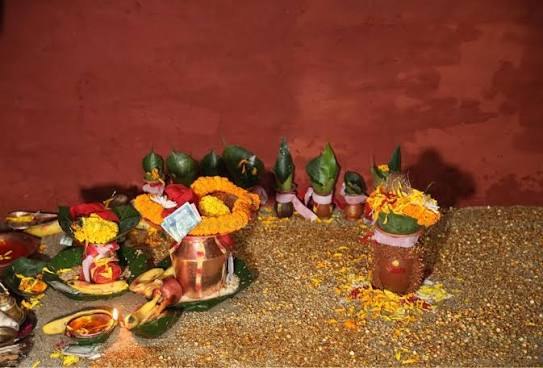
SATV, Kathmandu, October. 11- Nepal’s biggest Hindu festival, Bada Dashain, officially begins today, with Ghatasthapana, the ritual marking the start of the festival, being observed in households across the country.
Celebrated annually from the first day of the bright lunar fortnight of Ashwin until the full moon, Dashain lasts 15 days. On the first day, devotees establish a sacred pot (kalash), light oil lamps, worship Lord Ganesh and invoke Goddess Durga as part of the Ghatasthapana rituals.
During Ghatasthapana, devotees prepare a sacred space in their prayer rooms or Dashain worship areas and sow barley seeds in a mixture of sand or soil placed on a surface purified with cow dung. The resulting shoots, known as jamara, are considered sacred and are received along with tika and other offerings on Vijaya Dashami.
Barley sprouts are traditionally regarded as a favourite offering of Goddess Durga and a symbol of prosperity.
According to Professor Dr. Ramchandra Gautam, a religious scholar and former chairperson of the Nepal Panchanga Nirnayak Bikas Samiti, traditional scriptural practices prescribe barley as the grain to be sown for jamara. However, some families also sow other grains in accordance with their ancestral traditions. Jamara is also used in Ayurvedic preparations.
The ritual is called Ghatasthapana because devotees ceremonially establish a sacred pot representing the divine power of Goddess Durga and worship her. According to religious tradition, the water kept in the kalash is used for ritual consecration on Vijaya Dashami, when devotees receive the goddess’s blessings.
Auspicious Time for Ghatasthapana
According to the Nepal Panchanga Nirnayak Bikas Samiti, the auspicious time for Ghatasthapana this year is 11:47 AM on Sunday.
The committee said the Chitra constellation prevails throughout the day, and the auspicious time was determined according to traditional astrological calculations, taking into account the Abhijit Muhurta around midday.
Under Hindu scriptural traditions, Ghatasthapana should be performed on a day when the first lunar day, or Pratipada, coincides with sunrise. Based on this principle, the ritual is being observed today.
Nine Forms of Goddess Durga Worshipped During Navaratri
Throughout Navaratri, devotees worship three principal forms of the divine feminine: Mahakali, Mahalakshmi and Mahasaraswati. Mahakali represents power, Mahalakshmi symbolises wealth and prosperity, and Mahasaraswati represents knowledge and wisdom.
During Durga Paksha, special prayers are offered to the nine manifestations of Goddess Durga, who, according to Hindu mythology, defeated demonic forces including Chanda, Munda, Shumbha, Nishumbha and Raktabija.
The nine forms of Durga worshipped on successive days are: Shailaputri,Brahmacharini,Chandraghanta,Kushmanda,Skandamata,Katyayani,Kalaratri,Mahagauri,Siddhidatr. These manifestations are collectively known as Navadurga.
Dashain is traditionally regarded as a celebration of the victory of truth over falsehood and divine forces over evil. Its religious significance extends beyond any single caste or community.
A further tradition involves worshipping nine young girls during the period from Ghatasthapana to Mahanavami, with scriptural practices specifying that the girls should be at least two years old.
Major Rituals During Dashain
The seventh day of Dashain is marked by the arrival of Phulpati, an important collection of sacred flowers and other ritual offerings. Special worship ceremonies take place on Maha Ashtami and Maha Navami at Dashain prayer houses, military shrines and Shakti Peethas. In places where animal sacrifice is customary, rituals are performed according to local religious traditions.
Throughout Navaratri, devotees recite sacred texts, including the Durga Saptashati Chandi and the Shrimad Devi Bhagavata, along with other hymns dedicated to the goddess.
Major temples and Shakti Peethas, including Naxal Bhagawati and Shobha Bhagawati in Kathmandu, Nala Bhagawati and Palanchok Bhagawati, attract large numbers of devotees during the festival.
Navaratri comprises nine nights and ten days of worship. The goddess invoked during Ghatasthapana is ceremonially bid farewell on Vijaya Dashami, when families gather to receive tika, jamara, flowers and blessings from elders.
Vijaya Dashami on October 21
According to the Nepal Panchanga Nirnayak Bikas Samiti, Vijaya Dashami will fall on Wednesday, October 21, 2026 (Kartik 4 in the Nepali calendar).
The committee has set the auspicious time for the ceremonial immersion of the goddess at 8:49 AM, while the auspicious time for receiving tika and prasad is 10:26 AM.
The tradition of receiving tika, jamara and blessings from elders continues from Vijaya Dashami until Kojagrat Purnima, the final day of the festival.
On Kojagrat Purnima, devotees observe a fast and stay awake throughout the night to worship Goddess Mahalakshmi, who is associated with wealth, prosperity and abundance. Religious belief holds that the goddess blesses those who remain awake and worship her on this night.
The jamara planted on Ghatasthapana is also ceremonially immersed or disposed of in a clean, sacred place on Kojagrat Purnima, bringing the Dashain festival to a close.