




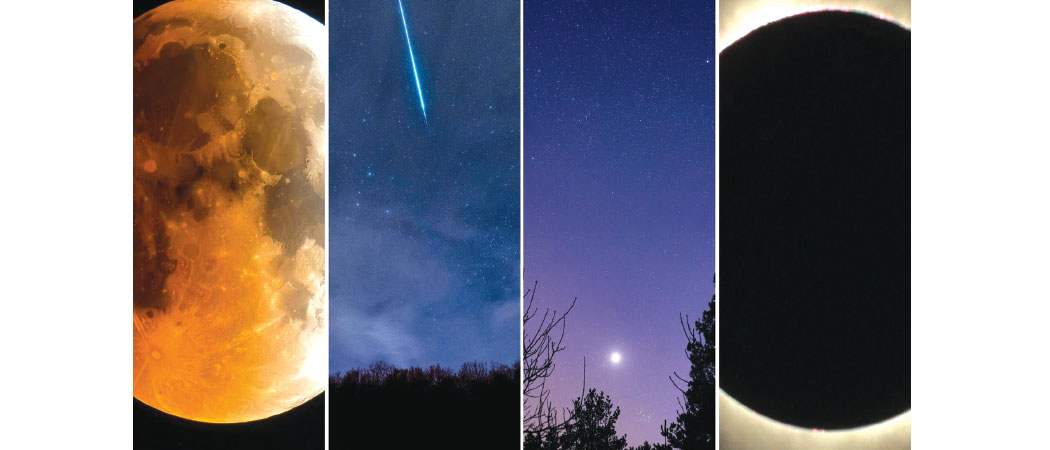
SATV, Kathmandu, Feb. 06: Elusive planet Mercury would be fleeting low in the western sky just after sunset. It can be succinctly chased in the constellation Capricornus (sea goat). Perceiving it in solar glare would be difficult. Mercury reaches its greatest eastern elongation from the Sun on 19 February. This can be the best time to enjoy the eccentric moments of Mercury since it will be at its highest point above the horizon in the western evening sky.
Planets Venus and Mars will be out of sight this month. They are gliding gleefully in the vicinity of the Sun through the triangle resembling the constellation Capricornus during daytime.
The mighty planet Jupiter with its mysterious moons can be relished richly from evening hours in the eastern sky after sundown in the commanding constellation Gemini (twins). It would climb high in the southern sky before midnight. It will be glistening like a shiny spot of lambent light in the western sky after the wee hours of the night till it sinks towards the western horizon.
The strange stars Castor (Kasturi) and Pollux (Punerbasu) decorate Gemini distinctly. The resplendent ringed planet Saturn can be seen shortly for a few hours in the western sky as dusk fades to darkness. It would be relaxing rejoicing below the confounding circlet asterism residing in the charming constellation Pisces (fishes).
The distant planet Uranus can be glimpsed greatly in the western sky after sundown from evening twilight till after midnight. It would be obviously obvious in the northeastern sector of the congenial constellation Taurus (bull). Red giant star Aldebaran (Rohini) is scintillating below Uranus. Far-flung planet Neptune would be appearing lamely in the western sky after sunset tersely in the constellation Pisces as a nib of illumination in a similar style as Uranus. It would be evanescent thereafter. Saturn is lustrously lambent below bluish Neptune.
The full moon can be favourably fascinated on 01 February. It is popularly recognised as the snow moon because the heaviest snows usually fall during this time of the year. Since hunting is difficult during harsh winters, this moon is also dubbed demandingly as hunger full moon. The new moon will betide on 17 February. Maha Shivaratri is observed with veneration on 15 February. Gayalpu Loshar is cheerfully celebrated on 18 February.
A rare but alluring annular solar eclipse transpires terrifically on 17 February. Such an eerie eclipse exceptionally occurs when the moon is too far away from Earth to completely cover the sun. This results in a rigorous ring of light around the darkened moon. The Sun's corona is not visible during an annular eclipse. This eclipse will only be visible in Antarctica and the southern Indian Ocean.
Attempting to spot an object near the Sun through binoculars or telescopes could immediately and permanently damage eyesight. Such actions, especially during solar eclipses, should be strictly avoided. Solar eclipses could be watched indirectly on projected images or after donning reliable eye protection with legally certified eye shades. This eclipse is dubbed a member of the Saros series 121. The Sun at the moment of eclipse will be blazing in the conjuring constellation Aquarius (water bearer).
A secretive 10-second signal from one of the most distant points in the universe had been detected, and experts are still attempting to unfathom its origins. Two earth satellites had confirmed that it came from a far-off source, a whopping 13 billion light-years away from us, likely exuding from an energetically exploding supernova when the universe was utterly 730 million years old. The faraway entity requires relatively more time for its light signal to reach us.
When we acknowledge a very distant explosion or star, we are actually looking at what had happened there billions of years ago, like a tantalising time machine showing us the past. The scientists believe that this high-energy gamma-ray burst, which they had named GRB 250314A, existed from the earliest supernova ever recorded from the dawn of time. Gamma rays are invisible and ultra-powerful forms of light. They are the most energetic source of radiation known in the universe and are produced by massive stellar explosions, appearing as super-bright flashes from our planet. Researchers are still unsure why this ancient supernova from the early universe behaved almost exactly like the exploding stars that are verified in our modern universe today.
If this explosion is the true source of the signal, NASA and the European Space Agency (ESA) expect early stars to be bigger, hotter and produce much more volatile explosions than the quirky signal suggested. This gamma-ray burst, GRB 250314A, is believed to be the source of the signal received from sheer 13 billion light-years away. This supernova, GRB 250314A, had probably exploded during the first billion years after the Big Bang. The signal was first identified on 14 March 2025, when the Space Variable Objects Monitor (SVOM) satellite picked it up as a sudden flash of high-energy light from deep space. Two studies on the possible source of this signal have just been released. The probe is a joint project between scientists in France and China designed to spot these kinds of bursts throughout the cosmos.
The signal recorded was a short and powerful burst of gamma rays, which are invisible waves of energy stronger than X-rays and capable of passing straight through the human body that could damage cells, DNA, and tissues. Since this burst likely came from the exploding star 13 billion light-years from Earth, the gamma rays that reached Earth were far too weak to pose any danger to humans. This burst lasted only about 10 seconds because gamma-ray bursts are like quick fireworks in space, releasing huge amounts of energy in a very short time before fading away.
Unlike random noise or background static in space, which is constant and weak, these gamma-ray bursts stand out as super-bright, focused beams with a unique pattern that human satellites have been built to recognise. NASA's James Webb Space Telescope (JWST) confirmed the discovery about three and a half months later, during the summer of 2025, by taking detailed pictures and measurements of the fading glow of the explosion, which could still be seen in space. The 10-second signal was recorded in 2025 by the Space Variable Objects Monitor (SVOM) satellite, operated by France and China. Only Webb could directly show that this light is from a supernova (collapsing massive star). Other sources of mysterious space noise like this might include solar flares or cosmic rays, but gamma-ray bursts are much rarer and come from massive events like star explosions that scientists are able to track down billions of years after they take place.
JWST is so advanced that it would be able to find more signals from when the universe was only 5 per cent of its current age, which is roughly 14 billion years old now. We know very little about the first billion years of the universe, what was happening in space during this time, or how stars behaved and died throughout the cosmos. Until now, it was thought that following the Big Bang, the massive explosion believed to have kick-started everything in existence, early stars lived much shorter lives and contained fewer elements than stars like our sun do today. However, in December 2025, the new studies analysed detailed observations from the Webb Telescope and found that this supernova from 730 million years after the Big Bang had the same brightness and radiation signature as exploding stars billions of years later.
GRB 250314A is a long-duration gamma-ray burst (GRB) detected on 14 March 2025, corresponding to approximately 730 million years after the Big Bang. This event is associated with the core-collapse supernova of a massive star, marking the earliest confirmed supernova explosion observed to date and surpassing the previous record holder at 1.8 billion years post-Big Bang. GRB 250314A provides critical insights into massive star formation and death during the Epoch of Reionisation, a period when the universe's neutral intergalactic medium was ionised by the first galaxies.
The burst was first detected by the Space Variable Objects Monitor (SVOM) [6][7] satellite and followed up by multiple international observatories, including NASA's James Webb Space Telescope (JWST), which confirmed the supernova and imaged the host galaxy, a compact, star-forming system resembling those from the reionisation era. The event's properties align with models of collapsars, where rapidly rotating massive stars collapse into black holes, producing relativistic jets. Discovery and observation of GRB 250314A were detected on 14 March 2025 by the French-Chinese SVOM satellite in the constellation Virgo (maiden). GRB 250314A offers direct evidence of massive star formation, explosions, and black hole seeding in the early universe, during reionization when the first galaxies ionised the neutral intergalactic medium. The supernova's similarity to modern events challenges predictions of more energetic explosions from metal-poor progenitors, implying collapsar-driven GRBs were producing black holes during one billion years post-Big Bang.
Gamma-ray bursts (GRBs) are the most powerful and violent explosions in the known universe. These brief flashes of high-energy light result from some of the universe's most explosive events, including the birth of black holes and collisions between neutron stars.
Lasting a few milliseconds to several minutes, according to NASA, GRBs can be hundreds of times brighter than an average supernova, making them as luminous as a million trillion suns. Thus, when a GRB erupts, it briefly becomes the brightest source of electromagnetic radiation in the observable universe.
NASA has announced dates for returning Americans to the moon after 53 years. It has been revealed that Artemis II, the first manned mission to the moon since 1972, will lift off earliest on 06 February from the launch pad at Kennedy Space Centre, Cape Canaveral, Florida in Orion spacecraft carried by NASA's powerful Space Launch System (SLS). However, the official launch window for Artemis II will remain open from 31 January to 14 February (Valentine's Day), with several alternate dates perhaps being picked out.
The mission will take three NASA and one Canadian astronaut on historically epic 10-day journey around the moon and back to earth. It will not land on the moon.
The lunar landing is envisaged to be undertaken by Artemis III in 2027. Artemis II will first orbit Earth a couple of times to test the life support equipment and then head toward the moon for a lunar flyby and close pass without orbiting or landing.
The spacecraft will utilise the moon's gravity to slingshot back toward Earth in so-called free-return trajectory mode, meaning if anything were to go wrong, it can safely return without the extra use of its engines. The main goal of this escapade will be to prove the rocket, spacecraft and systems work perfectly with humans on board, thus paving the way for Artemis III's landing next year.
It would land and establish a long-term presence of life on the moon led by America. What astronauts learn from the renewed missions to the moon will eventually help in future efforts to dispatch and settle mankind on Mars. The night skies of this winter month offer spectacular sights of numerous planets, stars, constellations and enchanting entities spreading superbly all over the heavens.