




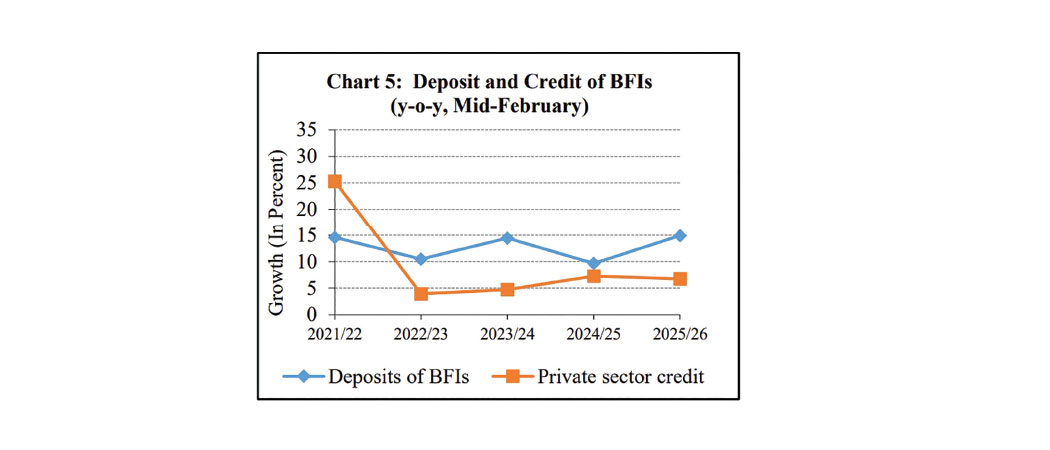
SATV, Kathmandu, Mar. 15 - Deposits collected by Banks and Financial Institutions (BFIs) increased by 6 per cent, adding Rs. 433.71 billion to reach Rs. 7,697.59 billion by mid-February 2026.
In the same period last year, deposits had grown by 3.8 per cent (Rs. 245.34 billion).
On a year-on-year basis, deposits expanded by 14.9 per cent.
According to the recent Macroeconomic and Financial Situation Report made public by Nepal Rastra Bank (NRB), the composition of deposits also shifted during the period.
Demand deposits accounted for 6.5 per cent of total deposits, savings deposits 42.8 per cent and fixed deposits 41.6 per cent.
A year earlier, the shares of demand deposits, savings and fixed deposit stood at 5.2 per cent, 34.8 per cent and 52.4 per cent respectively, indicating a noticeable rise in savings deposits and a decline in the proportion of fixed deposits.
The institutional deposits made up 34.3 per cent of total deposits in mid-February 2026, slightly lower than the 35.3 per cent share recorded a year earlier.
Meanwhile, credit extended by BFIs to the private sector grew by 4 per cent (Rs. 221.84 billion) to reach Rs. 5,719.54 billion in the review period.
This growth was slower compared to the 5.6 per cent increase (Rs. 283.46 billion) recorded in the corresponding period of the previous year.
On a year-on-year basis, private sector credit expanded by 6.8 per cent by mid-February 2026.
The shares of private sector credit from the BFIs to non-financial corporations and households stood at 62.6 per cent and 37.4 per cent, respectively, in mid-February 2026. Such shares were 63.8 per cent and 36.2 per cent, respectively, a year ago.
In the review period, private sector credit from commercial banks, development banks and finance companies increased by 4.2 per cent, 3 per cent and 1.8 per cent, respectively.
Out of the total outstanding credit of the BFIs as of mid-February 2026, 15.0 per cent is against the collateral of current assets (such as agricultural and non-agricultural products) and 63.8 per cent against land and building.
Such ratios were 14.4 per cent and 65.1 per cent, respectively, a year ago.
In the review period, outstanding loan of the BFIs to consumable sector increased by 10.6 per cent, construction sector by 8.7 per cent, transportation, communication and public sector by 6.8 per cent, industrial production sector by 4.8 per cent, and service industry sector increased by 1.1 per cent.
However, outstanding loans from BFIs to agriculture sector decreased by 1.4 per cent and insurance and fixed assets sector decreased by 1.9 per cent.
In the review period, trust receipt (import) loan extended by the BFIs increased by 16.2 per cent, margin nature loan by 11 per cent, hire purchase loan by 9.3 per cent, term loan by 3.1 per cent, real estate loan (including residential personal home loan) by 2.5 per cent, cash credit loan by 2.1 per cent and demand and other working capital loan increased by 1.8 per cent.
However, overdraft loan decreased by 3.4 per cent during the review period of the current fiscal year.