




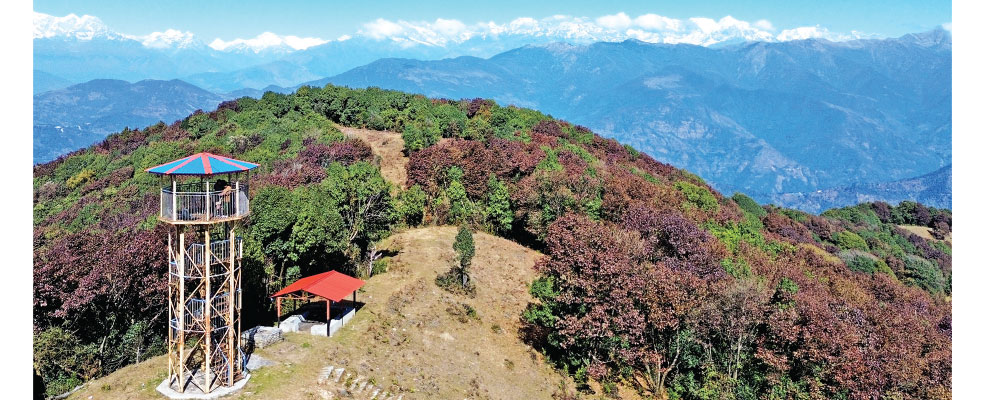
Khotang, Dec. 29: Rupakot, a stunning natural and culturally rich tourist destination in Khotang, has yet to gain the recognition it deserves.
Despite its potential to become a major attraction for both domestic and international tourists, the lack of publicity has kept it under the shadow.
Located at the top of the hill near the district headquarters of Diktel, Rupakot offers breathtaking panoramic views, including sightings of the world’s highest peak, Mount Everest, along with other majestic Himalayan ranges.
The area is not only a natural beauty spot but also holds significant historical and religious value.
According to local experts, when the weather is clear, Rupakot offers views of Everest, Cho Oyu, Lhotse, Makalu, and Ama Dablam, as well as several other smaller peaks.
Visitors can also enjoy the views of the internationally recognised Mundhum Trail and the last stop of this trail, Salpa Silichung. The region is home to wide-open fields and dense forests, offering opportunities for both short and long treks.
Various species of medicinal plants and endangered wildlife can also be found in the area, according to local environmentalist Surya Rai. The area’s diverse bird species fill the air with their songs, making it a haven for nature lovers.
To help visitors identify the variety of trees found along the hiking routes, the community forests in the area have installed nameplates on the trees. Rupakot is situated approximately five meters away from the Mid-Hill Highway, at an elevation of 2,600 meters. Visitors can access it on foot from Mude and Hurlung, which are connected to the main highway.
A few years ago, a view tower was constructed in Rupakot to boost tourism, but despite its potential, the lack of proper management and publicity has hindered the area from becoming a popular tourist destination.
Locals like Furlamu Sherpa from Mude say that on Saturdays and public holidays, staff and students occasionally visit Rupakot for picnics, though most people still stop at Bhulke, due to the lack of water facilities at the top.
Rupakot also holds great religious and cultural significance. Local legends tell of powerful figures such as lamas and yogis who once lived in the area, with a stone cave known as Jogi Kuti still standing as a symbol of their presence.
The site has been preserved by Buddhist followers, and even today, yogis and spiritual practitioners visit the cave.
Locals believe that meditation at the cave can provide spiritual powers, especially those associated with traditional healers or Dhami and Jhakri.
One of the most notable cultural sites in the area is Shiddhathan, a revered place of worship for the Rai community, where regular prayers and rituals are performed.
Educational activist Surya Rai, who has worked on promoting tourism in the region, highlights the need for better infrastructure, including the provision of water facilities and the construction of shelters.
Furthermore, Rupakot could be integrated into the larger tourism circuit by connecting it to the renowned Mundhum Trail, which passes through Halesi, another major religious site in Khotang.
Rai suggests that connecting the route from Halesi to Rupakot, and from there to the Mundhum Trail, could create a unique cultural and spiritual tourism route, attracting more visitors.
However, he stresses that the area requires better management and promotion to become a popular destination.