




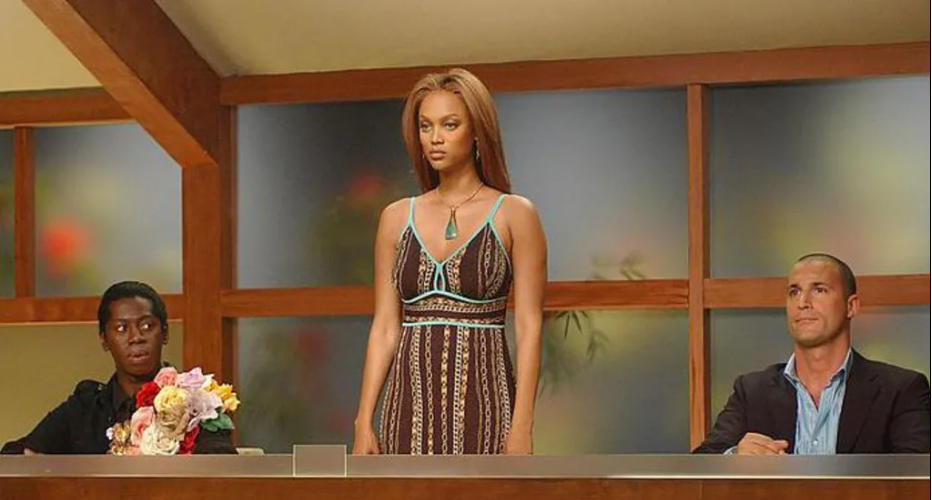
SATV, Kathmandu, Feb. 16 - "I was rooting for you! We were all rooting for you! How dare you?"
Tyra Banks' rant - angry and disappointed - at America's Next Top Model (ANTM) contestant Tiffany Richardson is the stuff of reality TV legend.
Watching the former supermodel lay into the young hopeful in front of millions of viewers still ranks as one of the show's most shocking moments, 20 years later.
But it is far from the only one.
Body-shaming, race-swapping, dangerous stunts and "humiliating" challenges were all ingredients of the show's huge success, keeping viewers hooked.
Even at its peak, ANTM ignited "how far is too far" conversations around reality TV shows.
But during the Covid-19 pandemic, when a new audience discovered it for the first time, they had one question.
"How did this ever get made?"
ANTM - which pitted a group of aspiring cover girls against each other in weekly photoshoot challenges - was a phenomenon.
It ran for 24 seasons - known as cycles - from 2003 to 2018, always attracting a new batch of hopefuls looking to win a 12-month contract with a top agency.
According to Tyra's own website, it has been shown in 170 countries and regions, with many of those launching their own local spin-off versions.
Someone who experienced both was Sophie Sumner, who first appeared on Britain's Next Top Model when she was 18-years-old.
Three years later, aged 21, she appeared on - and won - cycle 18 of ANTM - which saw UK models go up against US rivals in a "British Invasion" gimmick.
Sophie tells BBC Newsbeat the American edition of the show made the British version look like a "fluffy little competition" in comparison.
She recalls the judges picking apart her appearance - something she says did "mirror" the cutting modelling culture of the time, when colleagues were told to get boob jobs and expected to be "Kate Moss skinny".
But other challenges, notably making contestants "switch ethnicities", were just "trash on their end," she says.
"Everyone knew better."
As a contestant on the show, Sophie says the experience felt designed to push her buttons.
She says the production team persuaded her into doing a photoshoot on top of the 338 m (1,100ft) tall Macau Tower during a rainstorm - even after learning she had a fear of heights.
When asked whether she feels the show considered its duty of care to the models, she simply laughs.
"We didn't have any help on the show," she says.
"It was to get the drama. It was to get the ratings."
Sophie says she was "aware" of what producers wanted - and while the show did not propel her to stardom, she says she's "definitely grateful" for the platform it gave her.
It also gave her access to the US, where she's now based.
However, Sophie feels a lot of young girls plucked from small towns in America to appear on ANTM thought a "huge career" would follow.
But, more often than not, this was not the case.
ANTM's producers didn't have to contend with social media in the same way today's reality show makers do - at least in its early days.
But modern content creators such as Oliver Twixt have built a career on hyper-analysing every moment.
The YouTuber has interviewed more than 100 contestants on his channel, and tells Newsbeat he feels that by today's standards there could be questions over how some contestants were treated and portrayed.
However, he doesn't feel it is fair to judge ANTM by modern standards, and says that "hindsight is always 20/20".
"I do believe it is best to give it some grace and compassion because the show was created during the time where reality TV was very new," Oliver says.
"America's Next Top Model is one of the shows that pioneered the entire genre, on top of having a black woman be the face of the show.
"It was a new thing and they were going to make mistakes."
Others aren't convinced that it's so clear-cut.
Ebony Haith, who starred in the first cycle of ANTM in 2003, is one of the stories explored in an upcoming Netflix documentary which delves into some of the show's most standout controversies.
The model from New York, who was 23 at the time, was told by the judges that her skin texture looked "ashy" and she was described as "too harsh".
Ebony tells Newsbeat that she is "still healing" from the experience 23 years later.
"It seemed as though my race, my skin complexion, my hairstyle became so loud that I couldn't be this innocent girl having this fun experience," she says.
Over the years, viewers have argued the views and comments shared on the show were a product of their time.
But Ebony disagrees, and says plenty of people at the time were shocked by her treatment.
"The fact that an American show decided to take a black girl from New York named Ebony and to tell the world her skin texture was too rough," she says.
"It was amazing at how many people were embarrassed at the way I was treated on the show."
Ebony says those conversations have never stopped.
"I literally today will go on a bus. People will see me either put their heads down or they will start the conversation," she says.
She says that no-one from production has called her since to discuss or apologise for what happened and she has not seen Tyra since the series was broadcast.
The new Netflix documentary, Reality Check: Inside America's Next Top Model, will finally see Tyra and her fellow judges - Jay Manuel, J Alexander and Nigel Barker - address some of these shocking moments.
In it, Tyra says she created ANTM after facing adversity in the industry as a black woman.
She says she set out to make a show which reflected the diversity she felt that could, and should, be seen in modelling.
Former contestant Sophie does believe that, "deep down", the host did want to champion that cause.
But she feels Tyra "didn't know how to do it" and "getting ratings and making money probably became the overall goal".
"I'm sure that Tyra says that she got swept up in a machine and she had to get the ratings and she had so much pressure," she says.
"Like, I can hear it."
Sophie, who now works as a presenter and producer, believes the fashion industry has changed for the better, hailing the #MeToo movement as the "biggest defining thing", rather than Tyra.
"Could she have been the person to make the change? Of course, but other people then did that instead," she says.