




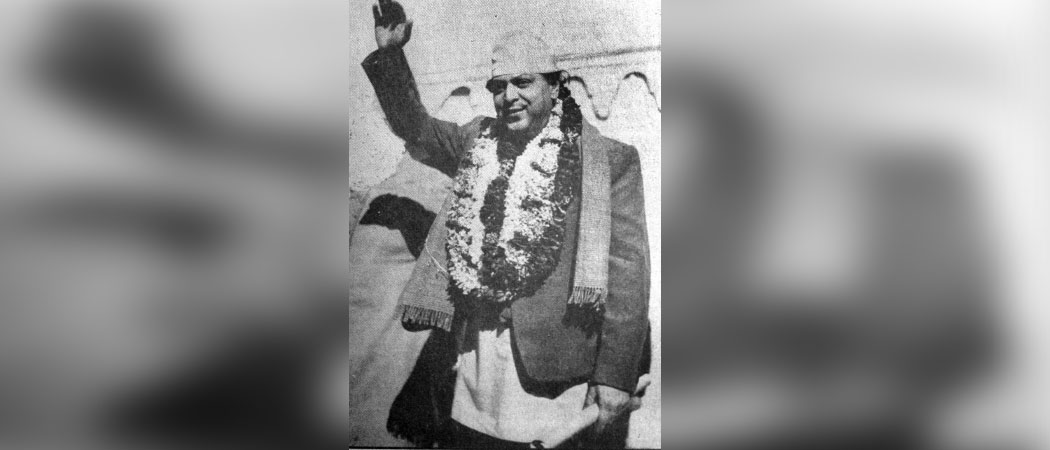
SATV, Kathmandu, Feb.20 - Understanding the national and international context of the political changes that occurred in Nepal in 1951 helps us grasp what modern-day Nepal needs to realise. By 1951, the Rana family regime had exceeded a century of rule — a rule that was not accountable to the people. There was deep-seated dissatisfaction among the Nepali public toward the Rana government, and the people wanted to overthrow it. The activities of Prachanda Gorkha (1927) and the Nepal Praja Parishad (1936) were products of this discontent. In 1940, the Rana rulers executed four members of the Nepal Praja Parishad, which further fueled public outrage against the regime. While this was the situation inside Nepal, the outside world was also undergoing massive upheavals.
After World War II (1939–1945), the global order began to change radically. A precursor to this shift was the Atlantic Charter, signed on August 14, 1941. In the spirit of that charter, a wave of independence from colonial rule was set to begin across many countries in Asia and Africa as soon as the war ended. The Rana rulers were watching these developments. The changes beginning to take hold in the world, particularly in India, would not leave Nepal untouched. Consequently, even before the end of the Rana regime, Rana Prime Minister Padma Shumsher established diplomatic relations with the United States on April 25, 1947. Shortly after, on August 15, 1947, India gained its independence.
Growing awareness
Nepalis had participated in the First and Second World Wars. They had seen a bit of the world outside and had also suffered the pain of Nepal’s poverty, illiteracy, and lack of development. Therefore, awareness was awakening among them regarding the need for political, social, and economic reforms in Nepal. In 1949, the communist revolution took place in China, and China emerged as a potential new global power. This was a matter of concern for India and the Western world. Simultaneously, following the end of WWII, relations between the Soviet Union and the United States were cooling, resulting in the establishment of the North Atlantic Treaty Organisation (NATO) on April 4, 1949.
The Rana rulers also saw no possibility of their family hegemony continuing. Probably for this reason, the last Rana Prime Minister, Mohan Shumsher, signed a Treaty of Peace and Friendship with independent India on July 31, 1950. He likely hoped that independent India would continue to support the Rana regime as did British India for its own reasons, but that treaty could not save them. The winds of change in Asia and Africa were blowing so strongly that Nepal couldn't remain isolated. There was a sense of suffocating restlessness among the few educated Nepalis; the desire for freedom was growing.
Independent India also saw the need for political change in Nepal. Before that change occurred, it signed the 1950 Treaty, the primary objective of which was India’s security guarantee. Although the Treaty retains the fundamental restrictive spirits of the 1816 Sugauli Treaty and the 1923 Nepal-Britain Treaty (which was said to be “improved”), the 1950 Treaty is more improved in favour of Nepal regarding its independence, sovereignty, and territorial integrity unequivocally spelled out in it. If we wish to further improve or review it, it is essential to understand the background of that treaty, study its language carefully, and understand today’s Nepal-India relations from the perspective of realistic international relations.
Around 1950, it wasn’t just the Nepali people who wanted change; King Tribhuvan also wished to escape the ‘golden cage’ in which the Rana Prime Ministers had confined him and wanted to rule directly. Jawaharlal Nehru, the first Prime Minister of independent India, was aware of this. Therefore, he arranged to take the King and his family to India in November 1950. The Nepali royal family reached New Delhi on November 11 in two military transportation planes sent from India. Around the same time, the Nepali Congress conducted an armed revolution for about three months, capturing various districts in Nepal.
Finally, King Tribhuvan returned to Nepal with his family and, on February 18, 1951, announced the formation of a new government – a coalition of the Rana and the Nepali Congress leaders.
The political instability and difficult transition that Nepal is currently navigating cannot be understood solely through internal domestic dynamics. Just as the political changes of 1951 were influenced by the outbreak of World War II in Europe, the relationship between Western Europe and America, the independence of India, and the rise of the People’s Republic of China, today’s global events will inevitably affect Nepal in many ways.
America, which emerged as the greatest global power after WWII, remains the most powerful nation today. However, after the collapse of the Soviet Union in December 1991 (which ended the bipolar world), China has become the second-largest economy and a challenger to the unipolar power of the United States—and it is our neighbour. This is a fresh new reality that we have to reckon.
Regional tension
In the past, Nepal had to strive for development while living amidst regional tensions, while the global Cold War felt somewhat distant. But today, the tensions of a ‘New Cold War’ have arrived in our immediate neighbourhood. India and China have become far more powerful than in the past. China is not only the second-largest economy after the US but appears on track to soon become the world’s largest. India has become the world’s fifth-largest economy and is on its way to becoming the third-largest. Therefore, we must internalise our geographical reality and seek the cooperation of all friends to achieve our economic development. If we do not develop the country economically, we will remain weak regardless of our diplomatic ingenuity.
Today, Nepal is on the threshold of general elections. Naturally, all friendly nations—particularly India, China, and the US—have shown interest in the upcoming elections, as seen through their recent actions and statements. At this time, we should not stand for or against anyone. The lesson of the 1951 transformation is that we can only move forward in the interest of Nepal by maintaining balanced relations with everyone.