




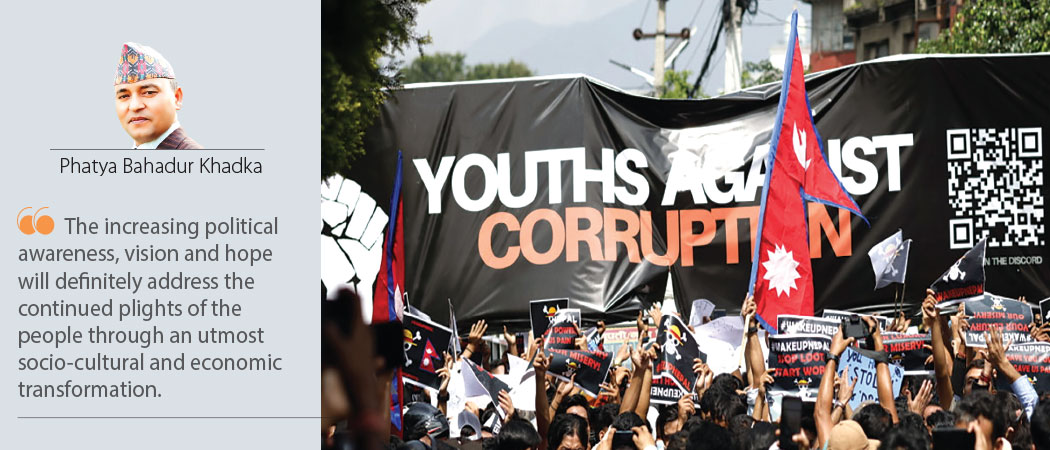
SATV, Kathmandu, Feb. 13: Political culture is crucial for shaping a nation into a strong thread of deep-rooted unity, shared beliefs, norms, and attitudes that people carry to uphold the political system and its values. It is a binding factor that helps shape how the general public in Nepal exercises authority and promotes inclusiveness in governance, and this article is aimed at analysing past and present political culture, values and ideologies with their changing dynamics. In the context of Nepal, political culture has evolved over centuries under various regimes and ruling systems, including the monarchy system, democratic experimentation, feudalism, and armed conflict. Nepal has finally entered the phase of republican transformation.
Various historical phenomena have compelled the creation of a unique set of political cultures, which are diverse, contradictory, and transitional, as they showcase both traditional sensitivities, awareness, and orientations, along with some contemporary democratic values and aspirations. Despite numerous political upheavals, the understanding of political culture, values, ideology, and norms remains inadequate. It means that the majority of ordinary people in a village are adopting it without understanding the actual political culture and ideology, which is significant to improve our political system.
Political scenario
Political culture can be stratified into three main key orientations: cognitive, evaluative, and affective, as these orientations relate to the political institutions and the state. Cognitive orientation refers to the knowledge and understanding that people have about the political system and its reality. It plays a vital role in examining the democratic state and teaches people to possess the required level of knowledge and understanding that separates the right from the wrong paths of democratic values.
Although the foundation of the political journey started long before, some level of cognitive awareness and superficial understanding of politics has increased significantly since 2007. Similarly, during the Panchayat rule, people had a different mentality of understanding the political system and governance, but after the restoration of democracy in 1990 and the People’s Movement of 2006, the cognitive level of understanding about the political happenings increased significantly. Similarly, the expansion of technology, media, education, sensitisation, and political mobilisation has intensified public awareness about constitutional provisions, elections, federalism, and rights.
However, this awareness level of the people remains discouraging. Compared to the rural people, the educated youths in some urban areas are found to have a higher degree of political awareness and knowledge. On the other hand, the marginalised and rural people in most of the communities still fall behind. Limited understanding of the general people about the political cultural norms and values hampers progress further, and educated youths tend to possess higher political knowledge, while rural and marginalised communities have a limited understanding of complex political institutions and their way of functioning and implementation as well, despite being politically mobilised and active only during political gatherings, activities, movements, election campaigns and other election days.
Affective orientation concerns emotional attachments toward political symbols, leaders, and institutions. Nepal’s political ideology and culture both demonstrate multiple orientations. Likewise, there is a strong emotional bond to democratic ideals such as inclusion and republicanism after the abolition of the monarchy in 2008. On the other hand, widespread frustration, distrust, and alienation still exist due to political instability, corruption, and unfulfilled promises. Respect for traditional symbols such as the monarchy and Hindu identity persists among certain sections of society, and some sections support multiparty sentiments; it is the ongoing revelation of emotional divisions within the political culture.
Evaluative orientation involves judgements about government performance and legitimacy. Nepali citizens increasingly evaluate governments critically, often expressing dissatisfaction with governance, service delivery, and accountability. The Gen Z revolt clearly indicates the deep discontent because of the frequent changes of government, weak implementation of policies, the Nepokids trend, the savvy lifestyles of so-called politicians, and elite-centred politics, but marginalisation at the local or grassroots level has contributed to declining trust and confidence in political parties and leaders.
Despite the consistent and unworthy participation in elections and numerous public debates and current political narratives around the people’s gathering at tea or coffee shops discussing criticisms and political shortfalls in governance, nobody is listening to the plight of the general people.
Components of political culture
However, political culture and ideology are being degraded because of the distorted nature and infected mentality. Nurturing of children in the values and norms of political culture at their earliest age is essential. "Morning shows the day" by John Milton, and "Child Is Father of the Man" is a song by the Beach Boys, created by Brian Wilson and Van Dyke Parks in the album Smile (1966-1967), which is entirely based on a popular 1802 poem by the great literary figure, William Wordsworth, "My Heart Leaps Up," that reflects that childhood experiences, conduct, habits and characteristics shape adult personality.
These two quotations/slogans clearly reveal how people in Nepal become political leaders and how political culture and ideology are built upon. Similarly, there is no effective education provision and policy to sensitise students about political culture. Nobody is taught properly how political leaders, parties, and their followers act according to democratic values. King Mahendra, BP Koirala, Ganesh Man Singh, and Madan Bhandari are regarded as the great political leaders, as they had a greater political ideology, vision, and culture to steer the nation towards the path of progress and prosperity. Likewise, these invaluable political norms, culture and ideology are disappearing, and on the other hand, people, as well as voters, are not able to choose their appropriate leader to run the nation in a result-oriented way.
Over the course of the different political upheavals, there are several factors that shaped Nepal’s political culture and ideology time and again. As our past historical events unfolded with a significant impact and influence so far. A few political movements and uprisings came into existence, and each movement was completed with a different end state, but it is a matter of concern whether the movement was orchestrated to fulfill the aspirations of the Nepali people, along with national interests and concerns, or just a superficial attempt to gain power and misuse it. It could be the thought-provoking questions to rethink twice for the movements to go on and on.
A few significant movements in the past, such as the end of the Rana regime, the 1990 People’s Movement, the Maoist insurgency, and the 2006 democratic movement, brought some kind of changes and different experiences to people fundamentally, but these movements were found to be bringing changes rather than transformation of the common people and were not able to connect its citizens wholeheartedly and not able to build rapport and not understanding the emotional intelligence of the people along with the state mechanism. Political parties thought that the abolition of the monarchy was the only option to bring peace, stability, and prosperity. On the contrary, there are numerous national and international factors affecting the stability, growth and progress of Nepal.
Changes do happen naturally, like political upheavals in the past, and if political parties had contributed to the nation’s transformation rather than changes, it would be a great achievement for the people in general, and if the governance could have supported the spirit of the Nepali citizens, there would not be this much discontent among the whole population, which was also demonstrated by Gen Zers in September 2025.
This is the right time for the political leaders to evaluate themselves and correct themselves to adapt themselves to the aspirations and plights and to sacrifice and contribute to the socio-economic transformation of the whole of Nepal. Moreover, people had thought that initially the declaration of Nepal as a federal democratic republic would strengthen national identity, rights, privileges, and political expectations, but it became quite the opposite, as it pushed the nation into adversity instead of prosperity.
Way forward
Despite many movements in the past, the political leaders built a political environment that could socialise and sensitise Nepali citizens easily to represent values and cultural norms. It brought a large segment of the people under the sole umbrella of unity, but it could not effectively enshrine Nepal’s actual values, norms, and national interests. Therefore, it is suggested that individuals, people, families, schools, political parties, media, and social movements should contribute their precious time for political transformation but also seriously dedicate themselves to shaping political culture and value.
The earliest socialisation of children about getting into political and cultural values, including ideologies, should be taught properly so that they internalise it during the adult stage of the political scenario. The technological advancements in social media and globalisation have intensified for political reasons, but at present, no major social platforms are endorsing national interests and criticising the wrongdoing of the political leaders and politicians. A few online media platforms are coming up, but these are acting as just a superficial attempt. Therefore, major media platforms can play a pivotal role in contributing to handling the existing polarisation of misinformation.
It is essential at this present juncture to have trust in honest, dedicated, selfless and result-oriented political leaders to steer the nation, whether they are from the old school or the new one. Similarly, the general people and voters should be conscious enough to choose their political leaders so that it determines the destiny of Nepal, a country rich in high prospects with a great future. Let the new hope and prospects happen peacefully with having a new political direction for Nepal and Nepali through the conduct of the upcoming elections. The increasing political awareness, vision and hope will definitely address the continued plights of the people through an utmost socio-cultural and economic transformation.