




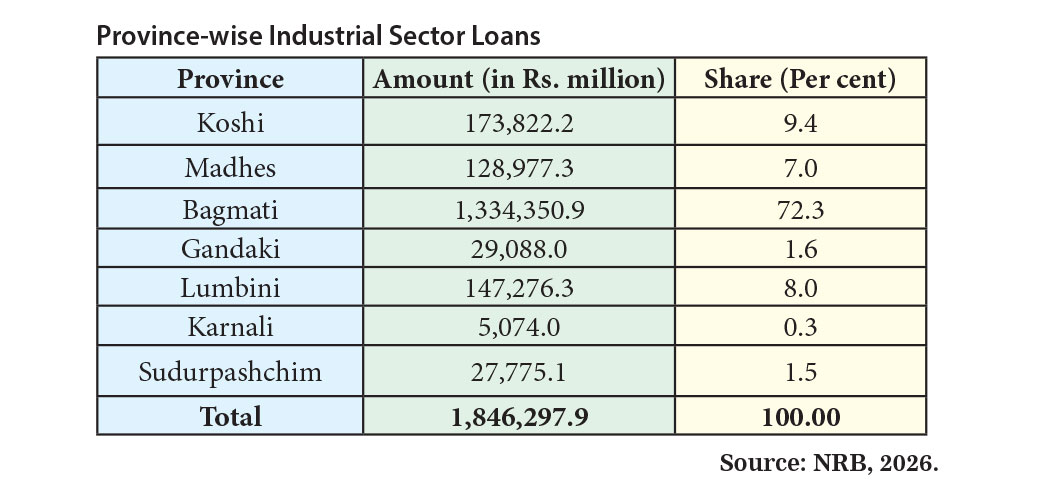
Satv, Kathmandu, Nov. 26: Distribution of industries and industrial loan has remained highly disproportionate among the seven provinces with Karnali witnessing its total share at just 0.3 per cent for formal credit disbursement from the banks and financial institutions (BFIs) while Bagmati takes 72.3 per cent share.
Of Rs. 1846.3 billion loan disbursed by the BFIs to the industrial sector, only Rs. 27.7 billion has gone to Karnali against Rs. 1334.34 billion of Bagmati, according to the latest Economic Activities Study report 2025/26 published by the Nepal Rastra Bank (NRB).
Sudurpaschim and Gandaki provinces have also emerged as poorly industrialised ones with their share of 1.5 per cent and 1.6 per cent in the total industrial loan mobilised by mid-July 2026.
The imbalance is so high that only 9.4 per cent industrial loan is mobilised to the second largest loan recipient province, Koshi.
The increased economic activities in Bagmati Province, especially in and around the Kathmandu Valley, has accumulated the wealth in this area and forced a large number of people to come and reside here because of the ever-growing economic opportunities.
Meanwhile, loans disbursed to the industrial sector by the BFIs increased by 8.64 per cent in mid-July this year compared with that of mid-July 2025, to reach Rs. 1846.3 billion.
The annual growth of industrial loan in the FY 2024/25 was 11.95 per cent, read the report.
Likewise, of total loans, the share of loans disbursed to the industrial sector stands at 31.02 per cent.
Of the total industrial loans, the largest share went to non-food manufacturing industries (33.37 per cent), followed by electricity, gas and water industries (27.26 per cent), agriculture, forestry and beverage industries (21.64 per cent), construction industries (13.24 per cent), and metal products, machinery and electronic industries (3.91 per cent).
The smallest share went to mining-related industries at 0.57 per cent.
Capacity utilisation slumps
The average capacity utilisation of the industries has gone down to 48.13 per cent in FY 2025/26 from 51.43 per cent in FY 2024/25, as indicated by the survey of 192 industries, said the central bank.
Among the industries covered by the study, the soybean oil industry recorded the highest capacity utilisation at 92.41 per cent, while the vegetable ghee industry recorded the lowest at 2.36 per cent.
The industries that witnessed increasing capacity utilisation include the producers of soybean oil, wheat flour, animal feed, biscuits, sugar, instant noodles, processed tea, liquor, beer, soft drinks, yarn, pashmina, garments, carpets, sawn timber, rosin, paint, bricks, cement and concrete.
However, capacity utilisation declined in industries producing vegetable ghee, mustard oil, processed milk, rice, chocolate, cigarettes, synthetic textiles, jute products, plywood, paper, pharmaceutical tablets, capsules, ointments, dry syrups, liquid medicines, soap, plastic products, polythene pipes, iron rods and sheets, steel products, galvanised iron (GI) wire, GI pipes, electrical wires and cables, tyres and tubes, and leather shoes and slippers.
Similarly, the average capacity utilisation has gone up in Koshi, Madhes, Gandaki, Lumbini and Sudurpaschim while it went down in Bagmati and Karnali.
Highest number of industry registration
A total of 857 industries were registered with the Department of Industry in FY 2025/26 which is the highest in the last six years.
The registered industries included 231 in the tourism sector, 79 in services, 149 in manufacturing, 27 in energy, 333 in information technology, 25 in agriculture and forestry, and 13 in the minerals sector. Of them, 82 were large-scale, 78 medium-scale and 697 small-scale, and 647 were registered in Bagmati Province. These industries proposed a total capital investment of Rs. 512.91 billion and the creation of 43,404 jobs.
About 700 industries were registered in 2024/25, 434 in 2023/24, 322 in 2022/23, 309 in 2021/22, and 203 in 2020/21.