




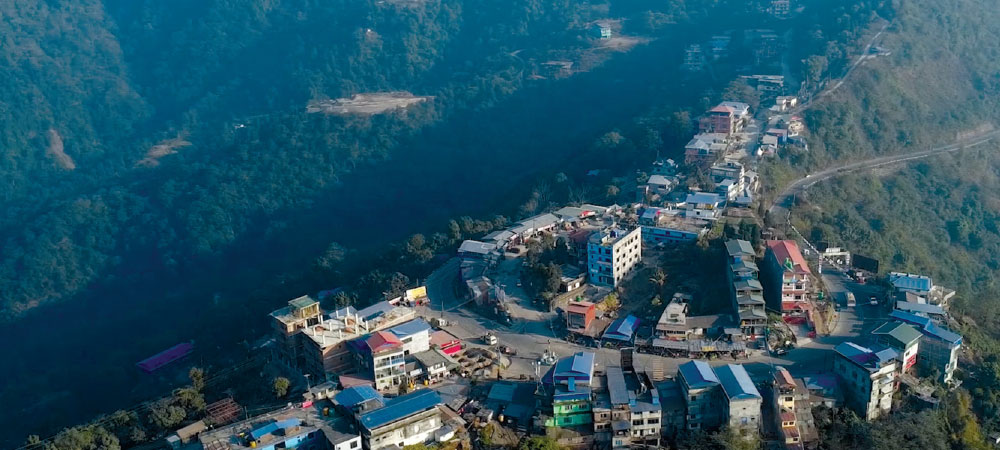
SATV, Kathmandu, Aug. 03 - Snow-capped mountain peaks stretch across the northern horizon, with rolling green hills below and a winding highway snaking through the landscape. To the south lie the fertile plains of the Tarai and the vast Koshi River spreading across the lowlands. Within moments, a blanket of mist covers the entire scene, only to clear again just as quickly.
This is Bhedetar, one of eastern Nepal’s most popular hill stations, renowned for its breathtaking natural beauty. The weather here, which is generally cool throughout the year, changes rapidly. One moment the area is shrouded in fog, and the next it is bathed in bright sunshine.
During the summer months, thousands of domestic tourists from the Tarai visit Bhedetar to escape the scorching heat. In winter, when cold waves grip the plains, the hill station often enjoys pleasant sunshine. As a result, visitors continue to arrive throughout the year. At present, more than 1,000 tourists visit Bhedetar on holidays, while around 300 arrive on ordinary weekdays.
Situated at an altitude of about 1,420 metres above sea level, the hilltop destination remains a favourite among both domestic and Indian tourists.
To cater to the growing number of visitors, more than 200 small and large hotels are now operating in Bhedetar, according to Tumraj Limbu, president of the Hotel Association Bhedetar. The association estimates that investments in the local hospitality industry have exceeded Rs. 2.5 billion.
A place once known for grazing sheep
Long before it became a tourist destination, Bhedetar served as a resting place for flocks of sheep travelling from the high hills to the Tarai.
Traders from Sankhuwasabha, Bhojpur, Tehrathum and Taplejung would drive their sheep through Dhankuta and Sangurigadhi on their way south to trade salt and other goods. The flocks were kept in what is now Bhedetar for several days to graze before continuing their journey.
Ramesh Shrestha, a local said the place came to be known as Bhedetar because sheep (bheda in Nepali) were grazed there. According to local accounts, this practice continued until around 1933, after which the area gradually became overgrown with forest.
The turning point came in 1977, when the road from Dharan reached Bhedetar. Small huts soon began appearing, serving simple snacks along with local delicacies such as dried meat (sukuti) and tongba, a traditional millet-based beverage.
Hotel entrepreneur Leelaraj Lawati said tourism began to flourish after the then Prince Charles of the United Kingdom visited Bhedetar in 1981, during the construction of the Dharan-Dhankuta Highway. After he climbed Sailung Danda and praised the area’s scenic beauty, both domestic and foreign tourists started taking an interest in the destination.
Over Rs. 2.5 b invested in two decades
Until around 1993, very few visitors stayed overnight in Bhedetar.
Seeing its potential, Bishnu Raj Shrestha, who had been running a hotel business in Kathmandu, decided to invest in his home district. In 1993, he established one of the area’s first lodges with accommodation facilities.
“Having worked at Hotel Annapurna in Kathmandu, I understood the kind of food and environment tourists preferred. I was confident a lodge here would succeed,” Shrestha recalled.
Tourist arrivals gradually increased, and hotel businesses flourished particularly between 1995 and 2001. Following the end of Nepal’s armed conflict, investment in the hospitality sector accelerated significantly.
According to Hotel Association President Tumraj Limbu, more than Rs. 2.5 billion has been invested in Bhedetar’s hotel industry over the past two decades. The growth has also encouraged investment in nearby destinations such as Namje, Debithan and Namaste Waterfall.
Today, Bhedetar and its surrounding areas can accommodate around 1,500 tourists overnight, he said.
New attractions continue to emerge
Bhedetar has continued to expand its tourism offerings in recent years.
A short distance uphill from the market lies Thumki and the picturesque village of Namje. A few years ago, the American news network CNN, included Namje among its 12 recommended travel destinations, attracting increasing numbers of both domestic and international visitors.
At the top of Thumki stands the Atma Ghar (Soul House), another emerging attraction. The structure was built by architects from the United States and several other countries using stones collected from 231 abandoned graves that once occupied the hilltop.
Around six kilometres from Bhedetar, the Okhre View Tower offers panoramic views of both the Tarai plains and the surrounding hills, drawing a growing number of visitors each day.
Eight kilometres towards Dhankuta lies Namaste Waterfall, another popular destination. Nearby are the historic Sangurigadhi Fort and the revered Pathibhara Temple.
Bhedetar has also developed into a hub for adventure tourism. A skywalk has been constructed at Sailung Danda near the town centre, attracting thrill-seekers. Other adventure activities, including a zipline, free-fall jump and giant swing, are also in operation, according to Sangurigadhi Rural Municipality chairperson Jitendra Rai.
“Bhedetar is no longer just a place to enjoy cool weather,” Rai said. “It is gradually emerging as a centre for adventure tourism as well.”