




Satv, Kathmandu,Nov. 26: I have long been drawn to Nepal–India border towns that flourished as commercial centres during the Rana regime but have since faded from public memory. Koilabas in Dang–Deukhuri and Thori in the Parsa–Chitwan border region have particularly stirred my curiosity. What once made these marketplaces vibrant, and why did their importance diminish? Visiting them offers a way to explore these questions beyond the pages of history, through roads, settlements, forests, and the traces of older journeys.
Recently, I travelled with a group of friends in a Scorpio along the Madi–Thori corridor, continuing via the Hulaki road to Pathlaiya and Hetauda before returning to Chitwan.
We had hoped to visit the Someshwar Hills, but time constraints forced us to leave that excursion for another occasion.
The range separates Madi from Bihar’s West Champaran district and forms a natural boundary between Nepal and India. Its ancient fort ruins and local temples add historical interest to the landscape, while the Indian side extends into the Valmiki protected forest area.
On the way, we stopped at the Ram Mandir in Ayodhyapuri. Former prime minister KP Oli’s assertion that this locality was Lord Rama’s birthplace brought it considerable attention, although the claim remains contested and should not be treated as established history. We photographed the temple and spoke with visitors before resuming our journey. The encounter offered a reminder that these borderlands contain overlapping layers of religious belief,historical memory, and contemporary political debate.
Our route followed a pebble-paved road through dense sal forest. After more than two hours, we reached Thori. Travelling along this stretch is particularly difficult during the monsoon, when swollen rivers and flash floods
can inundate temporary crossings, halt traffic, and strand travellers. The account of our journey points to continuing difficulties at the Ghanghar,
Bagai, and Magui Khola crossings, despite bridge construction elsewhere along the route. Their current construction status requires confirmation. As part of the Postal Highway network, this corridor holds the promise of improved connectivity, but the journey also reveals how strongly everyday mobility remains shaped by rivers, forests, and seasonal conditions.
Thori’s quiet appearance conceals a history of commerce, cultural exchange, and strategic importance. Adjoining Bihar’s Champaran region, the settlement once served as a gateway between the Gangetic plains, Nepal’s inner Terai and routes leading towards the mid-hills and Kathmandu Valley. A drive through Madi to Thori therefore follows more than a modern road: it traces the contours of an older borderland corridor through which goods, people, and political influence travelled.
The historical significance of the Thori pass reaches back to the Sen Rulers, whose domains included Makawanpur, Chaudandi, and Palpa. Control over passages linking the plains with the interior offered commercial advantages and strategic leverage. The relationship between Makwanpur’s Sen Rulers and Ramnagar, in present-day West Champaran, is associated with shared Rajput lineage, matrimonial connections, and economic interests. Thori formed a geographical hinge within this relationship, providing access across a landscape where hills and forests could otherwise impede movement.
These connections also gave the corridor a social character that cannot be understood through royal politics alone. Merchants, porters, and communities from the plains and hills encountered one another along the route.
Exchanges among Madhesi and Pahari populations helped shape the cultural fabric of the inner Terai. Rather than functioning simply as a boundary post, Thori was a meeting ground whose significance depended on the movement of people as much as on the authority of rulers.
Following the Anglo-Nepalese War of 1814–1816 and the Treaty of Sugauli, the corridor operated within a more clearly demarcated international frontier. The arrival of the railway at Bhikna Thori, on the Indian side, added
another dimension to its role. The branch extension is dated to 1906 in this account. Rail transport brought manufactured goods closer to Nepal’s border, where cargo could be transferred to porters, bullock carts, and pack elephants for the onward journey through Thori and Chitwan.
Manchester cotton, kerosene, iron tools, salt, and other manufactured goods travelled northward, while timber, forest produce, and mountain herbs moved towards markets in British India. The railway embankment invites an imaginative reconstruction of this traffic: steam engines arriving near the sal forests, cargo being unloaded, and caravans preparing to leave for
the interior. Such a scene helps explain why the old station mattered. It linked rail-based commerce in the plains with the slower, labour-intensive transport systems that carried goods into Nepal.
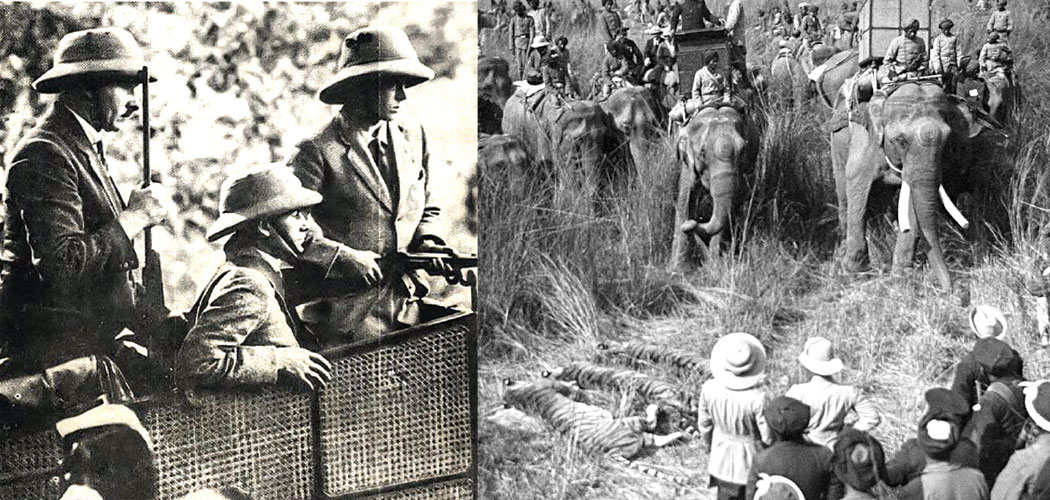
Commerce was only one aspect of the Thori–Madi corridor’s importance. Its dense sal forests and riverine grasslands also served as hunting grounds for Nepal’s Rana rulers and their British guests. These landscapes became settings for elaborate encounters in which hospitality,
spectacle, and political calculation were closely intertwined. Pandit Ambika Prasad Upadhyaya’s history of Nepal, including its discussion of Ramnagar, is cited in this account for the light it sheds on the connections between the borderlands and royal hunting.
The most prominent episode was King George V’s visit in 1911, following the Delhi Durbar in India. George V had succeeded Edward VII, who died in 1910. These names and dates are important to distinguish from the later visit of the Prince of Wales. Under Prime Minister Chandra Shumsher Rana, extensive arrangements were made to receive the British monarch in Nepal’s
southern forests. Hunting camps, transport facilities, and the organisation of attendants demonstrated the resources the Rana government could mobilise for an honoured guest.
Locations associated with the preparations included Sukivar and Kasara. Engineers were reportedly deployed to prepare a motorable route from the Bhikna Thori railhead towards the camps. The expedition is described here as lasting eleven days, although accounts sometimes distinguish between the length of the visit and the days spent hunting. After leaving Nepal, the king reportedly sent a telegram of appreciation during a stop at Narkatiyagunj in Bihar, thanking Chandra Shumsher for the hospitality and arrangements made in his honour.
A later royal visitor was the Prince of Wales, who came in 1921 and subsequently became Edward VII. His journey through Bhikna Thori again illustrates the railway’s importance as an approach to Nepal’s hunting grounds.
Camp preparations involved clearing areas near the Rapti River and organising soldiers, cooks, skinners, and other attendants. The logistical effort extended far beyond the royal party itself, drawing on labour and transport across the surrounding region.
Descriptions of these expeditions refer to hundreds of elephants and thousands of attendants. Figures such as 12,000 attendants and more than 600 elephants appear in reports. Elephants were used to surround stretches of tall grass in the so-called ring method, bringing animals within reach of hunters seated in howdahs. Whatever the precise totals, the scale of the arrangements conveys the extraordinary investment in these occasions. It also draws attention to the wildlife losses behind a spectacle celebrated by its royal participants.
These hunts were not merely sporting excursions. They were political theatre through which the Ranas cultivated relationships with British monarchs, viceroys, and aristocrats. Exclusive access to the forests offered a form of hospitality unavailable in ordinary diplomatic meetings. British guests could arrive by train at Bhikna Thori and proceed into carefully organised camps, where the grandeur of the arrangements reinforced the hosts’ prestige.
The landscape itself became an instrument of diplomacy. The expression “shikar diplomacy” captures this use of hunting to advance political relationships. The Rana government sought to protect Nepal’s autonomy while maintaining a close accommodation with British imperial power. The 1923 Anglo-Nepalese Treaty of Friendship belongs within this broader diplomatic history and formally appreciated Nepal’s independence. Royal hospitality may be considered part of the relationship that preceded it, but the treaty should not be presented as the direct result of hunting alone.
Military cooperation, negotiation, and wider strategic interests also require consideration.
British observers such as Brian Houghton Hodgson and Dr Henry Ambrose Oldfield documented aspects of Nepal’s geography, wildlife, and society. Their writings provide material for
understanding how outsiders perceived the Terai, although those perceptions must be read critically. Malaria constrained travel and settlement, but descriptions of an empty or uninhabitable wilderness obscure the presence of indigenous communities. The Tharu people’s longstanding relationship with the region deserves recognition without suggesting that they alone could survive there or that resistance to malaria amounted to complete immunity.
The ecological legacy is similarly complex. Restrictions associated with royal game preserves helped retain forest and wildlife habitat, yet the hunts themselves killed substantial numbers of animals. Later expeditions, including Lord Linlithgow’s visit in 1938, extended this history of elite hunting. Claims about the numbers killed should be tied to individual records rather than combined across visits. The subsequent development of Chitwan National Park in 1973, and protected areas in Parsa, marks a different purpose for these landscapes: safeguarding wildlife rather than reserving it for privileged hunters. This transition should not conceal the experiences of communities whose lives were shaped by successive forms of forest control.
As commerce shifted towards higher-capacity crossings such as Raxaul–Birgunj and Bhairahawa, Thori’s relative importance declined. The Bhikna Thori railway station fell into disuse, weakening a connection that had once sustained the border marketplace. Changes in transport networks altered the fortunes of a settlement whose prosperity had depended on its position between rail services in India and routes into Nepal. Its quieter present reflects these shifts rather than an absence of historical significance.
For a visitor today, the contrast can be striking. The landscape offers few immediate clues to the caravans, royal entourages, and diplomatic spectacles that once passed through it. Yet the forests, the old railway approach, and the corridor through Madi remain connected to that larger story.
Thori’s history brings together Sen-era regional relationships, cross-border commerce, Rana hospitality, British imperial interests, and changing approaches to wildlife protection. Each layer adds meaning to what might otherwise appear to be an isolated frontier settlement.
Our journey left me with a renewed appreciation of these overlooked border towns. Their decline does not erase their contribution to Nepal’s economic and political history. The challenge is to recover that history carefully, distinguishing documented events from inherited stories and impressive but uncertain figures.
Beyond the spectacle of royal hunts lies a borderland whose past deserves a fuller place in public memory.