




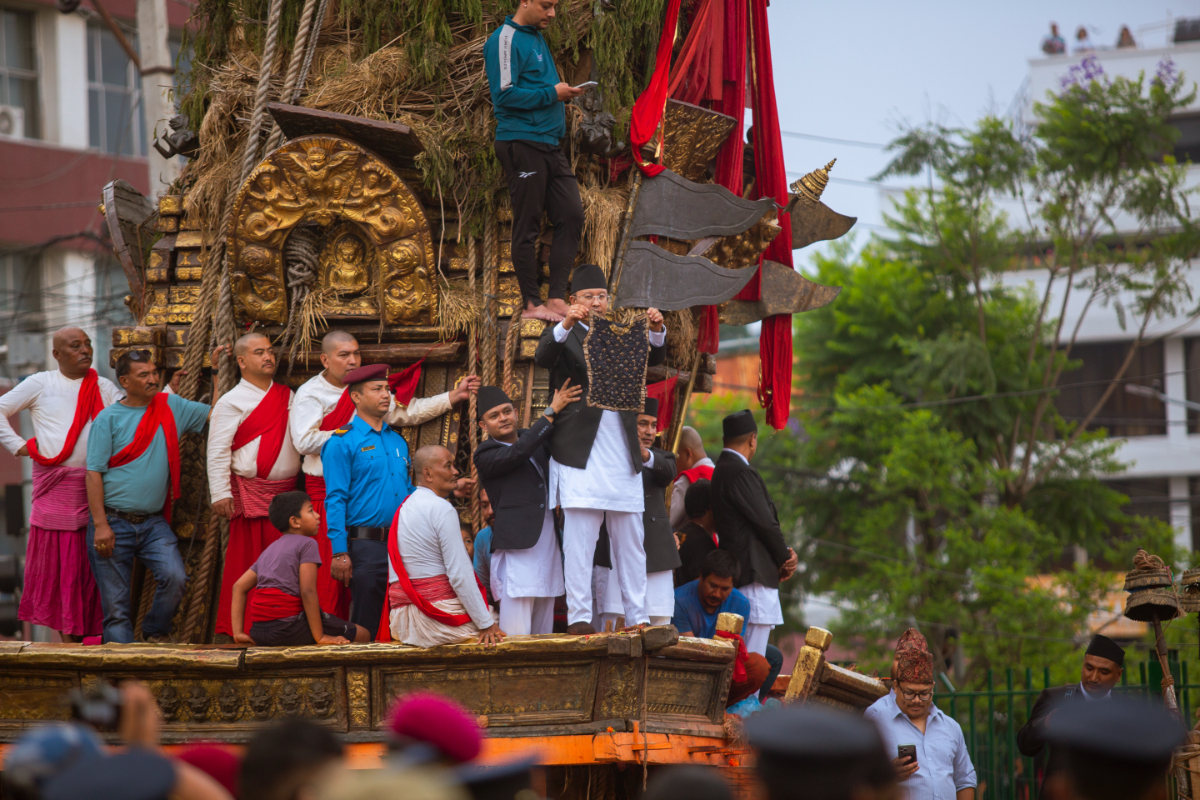
SATV, Kathmandu, Jun. 22 - As the evening advanced on Saturday, a large crowd gathered at Jawalakhel to witness the Bhoto Jatra, the sacred vest exhibition ceremony.
The over month-long Rato Machhindranath Jatra concluded on Saturday with the celebration of Bhoto Jatra, one of Nepal’s oldest and most significant chariot festivals. The highlight of the ceremony was the public display of a sacred jeweled vest (Bhoto) from the chariot of Rato Machhindranath, revered as the rain god.
President Ramchandra Paudel attended the ceremony as the head of state. Other dignitaries, including Vice President Ramsahay Prasad Yadav, Prime Minister Balendra Shah, Home Minister Sudan Gurung, other ministers, political leaders and senior officials were also present.
Representatives of the Guthi Sansthan, Lalitpur, displayed the Bhoto from the upper platform of the chariot as thousands gathered to witness the ritual. Before being shown to the public, the vest was first shown to Rato Machhindranath. It was then displayed from all four sides of the chariot.
After the official exhibition ended, the President received tika and prasad of Rato Machhindranath, circumambulated the chariot, and received prasad from Kumari, the living goddess of Patan.
Every year, Bhoto Jatra has been celebrated amid large crowds. However, the exact date of its origin remains uncertain, though it is believed to have begun during the Lichhavi period (3rd–9th century).
According to legend, a Newar farmer received the vest from a serpent god after curing his queen but later lost it. When the vest reappeared on someone else, ownership was disputed and never resolved, prompting its annual public display in hopes the rightful owner would come forward.
Another legend recounts that during a severe drought in the Kathmandu Valley, King Narendra Dev brought Machhindranath from Kamakhya, Assam, to Nepal, ending the famine. It is believed Gorakhnath’s meditation had suppressed the serpents, causing drought. With Machhindranath’s arrival, Gorakhnath rose, freeing the serpents and bringing rain. In celebration, locals began the chariot procession, originally known as Jawalakhel Jatra, linked to offerings of rice.
According to the Guthi Sansthan of Patan, after the ceremony, the idol of Rato Machhindranath was taken to Bungamati.
Bhim Ratna Shakya, one of the priests, explained that among the 32 priests of Rato Machhindranath, those whose turn came this year carried the idol in a palanquin from Jawalakhel to Bungamati.
People from Bungamati joined in, bringing the god from Chhyasikaot of Bahisepati. Along the way, they burned barley stalks, and the evening processions were filled with traditional music and chanting.
After the palanquin of Rato Machhindranath reached the temple of Bungamati, the spouse of the main priest performed the ritual of bringing the god inside and placing the idol in its rightful place.
Since last year, the idol of Rato Machhindranath has been kept inside the temple following the completion of the Shikhar-style temple, which had been damaged by the devastating earthquake in 2015.
The chariot of Minnath has also been returned to the temple of Tangal from Jawalakhel. Today’s festival concluded with the display of the Bhoto and the return of the deity to Bungamati.”