




SATV, Kathmandu, Sept. 5: Nepal Oil Corporation (NOC) has been making efforts to ensure the smooth supply of petroleum products, including cooking gas, to Kathmandu Valley and surrounding districts.
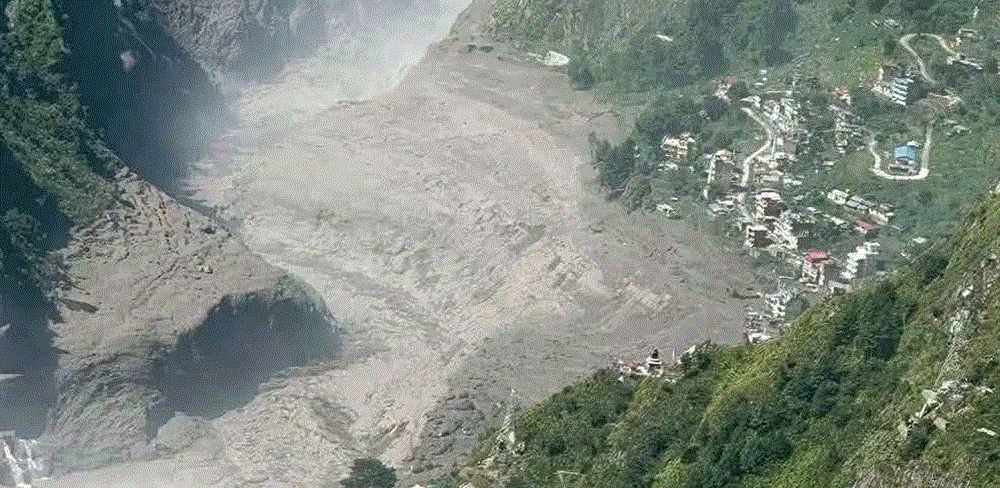
It has arranged alternative routes to maintain the supply of petroleum products and liquefied petroleum gas (LPG) to Kathmandu and surrounding districts after the Trishuli River damaged a section of the Prithvi Highway at Krishnabhir, disrupting the movement of fuel tankers and LPG bullet tankers along the regular route.
The Bhotekoshi River flood on August 26 caused extensive loss of life and property in Rasuwa, Nuwakot and Dhading, prompting large-scale search, rescue and relief operations in the affected areas.
According to the NOC, petroleum products being supplied to Kathmandu Valley are currently being transported via the Tribhuvan Highway, commonly known as the Bairoad, as the Krishnabhir section of the Prithvi Highway remains obstructed.
Spokesperson for the NOC, Manoj Kumar Thakur, said that the petroleum products, especially petrol and diesel, are being smoothly transported by tankers through the alternative route to Kathmandu and surrounding districts.
“However, it is not easy to transport petroleum products via the Tribhuvan Highway, as the journey takes considerably longer and the road is also experiencing heavy traffic pressure,” he said.
It takes at least an additional 13–14 hours to transport petroleum products via this highway, compared to the usual six to seven hours via the Prithvi Highway.
“In this situation, consumers should also act responsibly and reduce their consumption, if possible, considering the challenges involved in supplying petroleum products through alternative routes,” said Thakur.
The daily demand for petrol in Kathmandu Valley stands at around 700,000–800,000 litres under normal circumstances.
He said the NOC is making every effort to bring in fuel according to the needs of Kathmandu Valley, while there is no problem with imports from Indian Oil Corporation (IOC) through the pipeline.
Efforts underway to increase supply
As for liquefied petroleum gas (LPG), supplying the cooking gas to Kathmandu Valley and surrounding districts has become challenging as LPG bullet tankers have been unable to enter the Valley, as the Tribhuvan Highway also remains disrupted.
To maintain LPG supplies, the corporation has made arrangements to fill cylinders at plants in the Tarai and transport them to Kathmandu through alternative routes.
Meanwhile, LPG industries have started bringing filled cylinders to Kathmandu Valley after filling them at plants in other districts, said Diwan Bahadur Chand, president of the Nepal LP Gas Industry Association.
“Around 18,000 LPG cylinders of various brands were arranged for delivery to the Valley on Wednesday, and gas companies plan to continue and increase the supply in the coming days,” said Chand.
According to him, however, it would be difficult to meet the Valley’s demand for cooking gas solely by transporting cylinders filled at plants in other districts.
“We have arranged for cylinders to be filled in Hetauda and other districts and have also arranged trucks through transport entrepreneurs. However, heavy traffic on the alternative routes has made it difficult to supply LPG to Kathmandu Valley on time,” he said.
He said it was also challenging to transport empty cylinders stored in Kathmandu to bottling plants, as the plants in other districts have a limited number of cylinders available for filling.
According to Chand, the association has held discussions with government officials to allocate separate time slots for vehicles carrying LPG so that supplies can move smoothly.
“If the government makes such an arrangement, we can supply at least 50,000 cylinders to Kathmandu Valley,” he said.
The daily demand for LPG in Kathmandu Valley stands at around 35,000 to 40,000 cylinders, NOC spokesperson Thakur said, adding that LPG companies are making every effort to supply as much as possible, depending on their capacity and road conditions.
Of the 57 LPG companies operating across the country, 22 supply cooking gas to Kathmandu Valley. Of these, 18 companies have been unable to fill cylinders at their own plants because LPG bullet tankers cannot reach their facilities due to road disruptions. The remaining companies have also faced difficulties transporting filled cylinders to Kathmandu.
However, the 18 companies have continued supplying LPG to Kathmandu Valley by filling their cylinders at plants operated by other gas companies.
Of these 18 companies, two, including Nepal and Everest, used to fill cylinders at their plants in Kathmandu. Four others, including Sagar, Himal, Lokpriya and Surya, used to fill cylinders at their plants in Kavrepalanchok.
The remaining 12 companies, including Sugam, Sreeram, Shree and STC, used to fill cylinders at their plants in Dhading.
According to Chand, transporting filled cylinders by trucks after bullet tankers are unable to reach bottling plants has increased both transportation costs and delivery time.
An LPG bullet tanker can carry the equivalent of around 1,250 cylinders.
He said that, due to traffic congestion, it takes at least three days to complete a round trip.
“Due to the increase in transportation costs, we have increased the price of a filled cooking gas cylinder by Rs. 105 to Rs. 2,165. The price of a cylinder in Kathmandu was previously Rs. 2,060,” he said.
He said the additional cost of supplying LPG to Kathmandu Valley would be reduced once the Prithvi Highway resumes operation.