




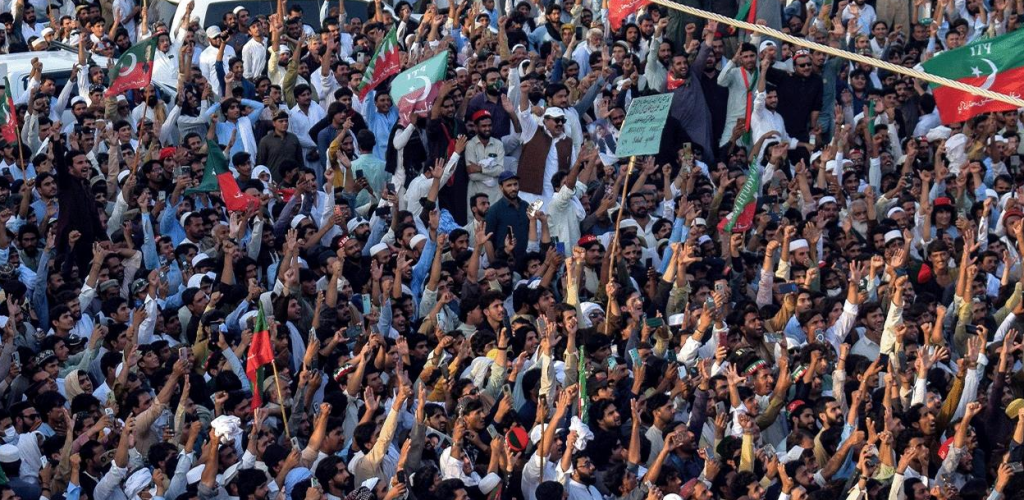
South Asia Network Television, Kathmandu, October 15: Pakistan’s diplomatic and political crisis has intensified following the declaration of an emergency in Khyber Pakhtunkhwa (KP), a province considered the main political stronghold of former Prime Minister Imran Khan, and the suspension of the provincial government.
Schools have been closed, internet services partially disrupted, freight containers placed across roads, and military personnel deployed for patrols.
The Pakistani government has defended the move as a constitutional measure intended to protect citizens from the threat of terrorism. Information Minister Attaullah Tarar has accused the provincial government led by Pakistan Tehreek-e-Insaf (PTI) of colluding with terrorists. However, no concrete evidence has been made public to substantiate the allegation.
‘Long March’ and Arrest of Chief Minister Sohail Afridi
The government imposed the stringent measures shortly after thousands of Imran Khan supporters launched a ‘Long March’ in Khyber Pakhtunkhwa, where the PTI has maintained a strong political presence for the past 13 years. The protesters are demanding Khan’s release from prison.
Chief Minister Sohail Afridi, who was leading the demonstrations, was reportedly taken into custody by security personnel on what authorities described as security grounds. The PTI, however, maintains that he has been arrested.
Many PTI leaders have reportedly gone into hiding, while security forces have used tear gas against protesters taking to the streets.
In September, three of Imran Khan’s sisters were also arrested on allegations of mobilizing supporters. They remain in custody, according to the report.
Political Vendetta or Military Dominance?
According to observers, the primary motivation behind the emergency declaration may not be counterterrorism but an attempt to remove the opposition from power and keep it under pressure.
Farzana Sheikh, an associate fellow at Chatham House, and defence analyst Arifa Noor have criticized the government’s move, describing it as disingenuous and warning that it leaves little room for dissent or political protest.
Political analyst Zahid Hussain says Pakistan’s balance of power has shifted decisively in favour of the military. He suggests that the military has become more confident following what it perceives as an improvement in its international standing due to Pakistan’s role in US-Iran peace negotiations.
Michael Kugelman, a senior fellow at the Atlantic Council, has warned that the government’s decision could backfire.
“Playing with fire,” he cautioned, warning that if the measures fuel further public anger and resentment, the situation could become impossible for Islamabad to control.
Pakistan Faces a Multidimensional Crisis
Imran Khan, 73, has been imprisoned since August 2023 and faces more than 100 cases. The PTI has consistently described the cases against him as politically motivated.
The latest government action has pushed Pakistan into an even more complicated political situation.
According to the Global Terrorism Index 2026, Pakistan ranks as the country most affected by terrorism worldwide. Islamabad has repeatedly carried out airstrikes in Afghanistan and accused the Taliban government of providing shelter to terrorists. Meanwhile, tensions with neighbouring India remain high, with the possibility of renewed conflict continuing to pose a threat.
Pakistan has also pledged security assistance to Saudi Arabia amid escalating tensions involving Yemen’s Houthi rebels.
With the provincial government suspended and authority concentrated in the hands of Islamabad and the military, concerns are growing that the move could intensify resentment in Khyber Pakhtunkhwa and push Pakistan further towards internal conflict and political instability.