




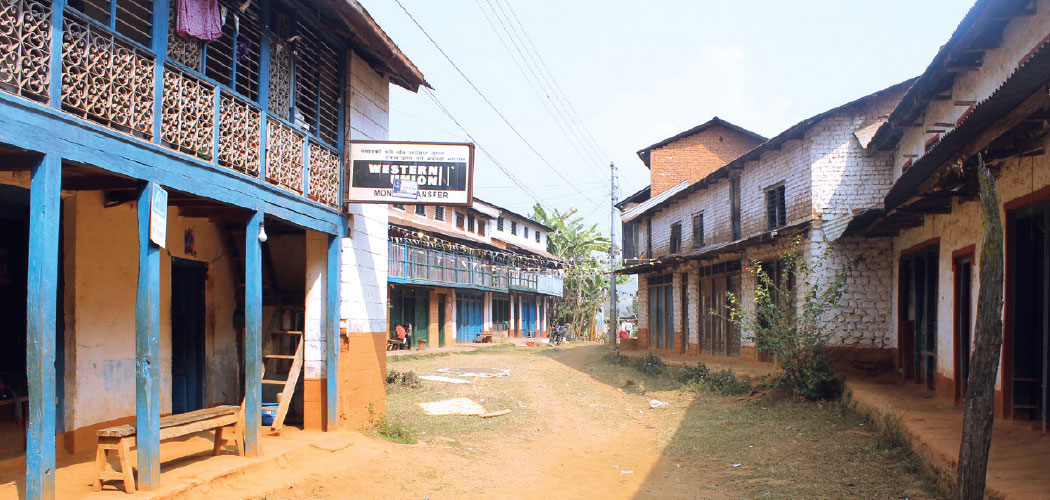
Satv, Kathmandu, Nov. 29: Markets in Parbat district, once bustling with hundreds of people and vibrant commercial activity, are now falling silent. The expansion of road networks, which has displaced traditional foot trails, the growth of local markets in villages and the delivery of public services at the local level have put the very existence of these old trading centres at risk.
Kamale Bazaar in Ward No. 4 of Phalebas Municipality, Modibeni and Jhaprebagar in Wards 7 and 9 of Kushma Municipality, Malyangdikhola, Bhorle in Paiyun Rural Municipality, Mallaj in Jaljala Rural Municipality, and Lunkhu in Mahashila Rural Municipality were once among the district’s busiest marketplaces.
However, the commercial vibrancy that once defined these places has largely disappeared, of late.
Kamale Bazaar was once a major trading hub in the southern part of the district. People from different parts of Parbat, as well as neighbouring Baglung district, used to visit the market to purchase goods. Today, not even a single shop remains operational.
“We used to have to wait in a queue for three hours just to buy a kg of sugar,” said Madhav Gaudel, a local resident of Kamale Bazaar. “The market has entirely lost the vibrancy.”
According to local resident Nareshwar Poudel, trade flourished in Kamale Bazaar from 1974 to 1998. Of the more than 15 traders, including Kamal Bhusal, Rudra Bhusal, Balkrishna Tiwari, Tikaram Gaundel, Nandalal Tiwari and Nareshwar Poudel, who ran businesses there between three and five decades, many have since switched professions.
Balkrishna Tiwari, who operated a business in Kamale Bazaar for three decades, said daily transactions at the time exceeded Rs. 60,000.
The price of land had reached as high as Rs. 45,000 per haat (an arm's length), he said.
“Even when we were willing to pay the asked price, it was difficult to find land for purchase. Eventually, many traders, including myself, shifted to the district headquarters,” he said. “Looking back, those days now seem like a dream.”
Tiwari, who used to run a fancy goods and photography business in Kamale Bazaar, now operates a business in the district headquarters. Kamal Bhusal, who ran a business in the bazaar for more than 22 years, has also relocated his business to the district headquarters.
Before the expansion of road networks in the Dhaulagiri region, people from Baglung, Myagdi and Mustang used to travel through Parbat’s old markets on their way to Butwal to purchase daily essentials such as salt and cooking oil.
Malyangdikhola, located on the border between Phalebas and Kushma, once had more than 60 hotels. Locals say the market remained busy throughout the day, with porters constantly passing through. Similarly, Modibeni and Jhaprebagar were once well-known commercial centres. Khil Prasad Bhusal, who operated a hotel in Modibeni until 2001, has since returned to his village. Devi Prasad Adhikari, another hotelier who used to record daily transactions exceeding Rs. 100,000 in Modibeni, now lives in Kathmandu.
Ek Narayan Adhikari, who used to run a business serving meals to hundreds of porters at Seulibazaar in Ward No. 9 of Kushma Municipality, has now given up the business and stays at home.
“When I recall those days, they seem like a dream,” he said. “Today, even this route has disappeared.”
The opening of the Pokhara-Baglung road track in 1991 gradually reduced the movement of people along the old foot trails. In recent years, the expansion of roads to villages has further diminished activity in the traditional markets.
According to Tikaram Gaundl, a former ward chairperson of Ward No. 4 of Phalebas Municipality and a former trader, the displacement of traditional foot trails following road expansion led to the decline of the markets situated along them.
“Once roads came into operation, all the old, busy trails disappeared. People who once travelled on foot now speed past in vehicles,” he said. “New commercial hubs have emerged at designated locations, while many old markets have been reduced to ruins.”
Over the past decade, road networks have expanded to most villages in Parbat. Locals estimate that more than 80 per cent of the old mule tracks have been displaced. The earlier compulsion to travel to Butwal to stock up on salt for the entire year has also ended. With roads reaching villages, daily essentials are now readily available close to people's homes.
According to Sher Bahadur Sunar of Pangrang, people in the past had little choice but to travel to Batauli (Butwal) to stock up on salt, otherwise, they had to make do with salt-free food.
With roads reaching their villages, local residents have also become less accustomed to visiting traditional markets. While locally produced food used to meet the daily needs of households, food products imported from India and China have now also become readily available in villages.
The implementation of the federal system of local governance has also affected trade in Kushma, the district headquarters, according to local businesspeople. Before local governments became functional, secretaries of the district’s 55 Village Development Committees (VDCs) were based in the district headquarters and provided services from there. With an average of 10 service seekers visiting the headquarters from each VDC every day, the daily footfall reached around 550 people.