




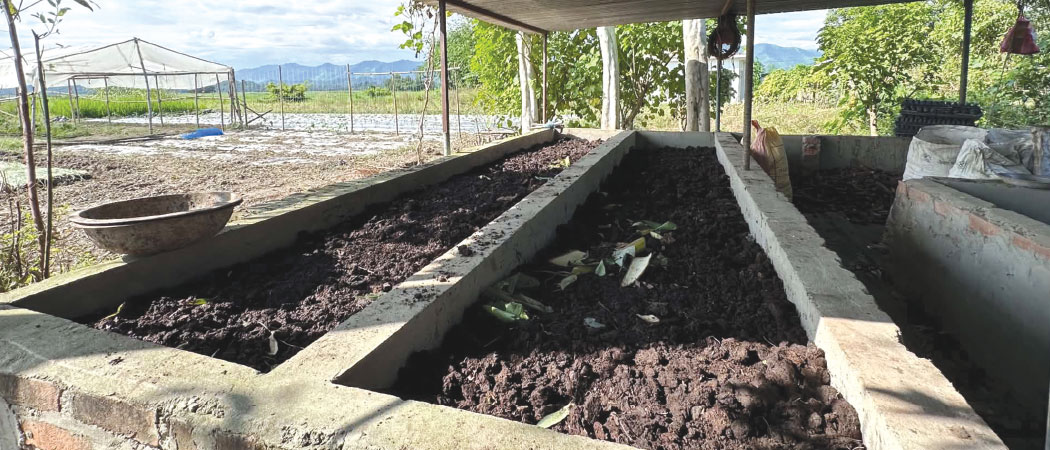
SATV, Kathmandu, Sept. 10: Farmers in Dang have increasingly turned towards producing and using organic fertilisers after noticing a decline in soil fertility caused by the continuous use of chemical fertilisers.
Anita Chaudhary of Tabdapur in Rajpur Rural Municipality-2 has been producing vermicompost and using it on her own farm. She said she had noticed an improvement in soil quality since adopting the practice.
Chaudhary began producing vermicompost three years ago. She now uses it on her own farm and sells the surplus. After receiving training on vermicompost production from the Rural Women Uplift Centre, she began producing the fertiliser using organic materials readily available in her village.
“I felt that the soil was deteriorating with the continued use of chemical fertilisers. That is why I started making vermicompost,” she said. “We now also produce organic fertilisers and pesticides using resources available locally.”
According to Chaudhary, vermicompost has not reduced crop yields. Instead, she has observed an improvement in soil quality. Along with vermicompost, she also produces compost and liquid fertiliser. She said surplus vermicompost is sold for Rs. 25 to Rs. 30 per kilogramme.
She said demand for organic fertiliser was also increasing as consumers became more interested in organically produced food.
“The cost of organic production is somewhat higher. But more people are becoming aware of the need to eat organic food,” she said. “As a result, demand for organic fertiliser is also increasing.”
Ramashraya Chaudhary, a lead farmer from Kathberuwa in Rajpur Rural Municipality-1, has also been producing and using vermicompost for the past three years. He uses the organic fertiliser on one and a half bighas of land.
He said the use of vermicompost had increased production while also improving soil quality. According to him, it takes at least three months to prepare vermicompost.
To expand organic and regenerative agricultural practices adopted by local farmers, the Rural Women Uplift Centre, with support from Heifer International Nepal, is implementing the Vita Project in Gadha and Rajpur rural municipalities.
The project is being implemented as a demonstration and learning initiative on regenerative agricultural technologies for healthy soil, with 20 lead farmers from the two municipalities participating.
As part of the project, 10 lead farmers each from Gadha and Rajpur have received training and technical support on producing and using vermicompost, compost, Jeevamrit, Panchagavya, liquid fertiliser and green manure, according to Aasmani Chaudhary of the Rural Women Uplift Centre.
The project focuses not only on the use of organic fertilisers but also on drip irrigation, organic mulching, biochar, tunnel farming, promotion of indigenous crop varieties, improved farmyard manure, and the use of organic fertilisers and pesticides.
Farmers are using organic and environmentally friendly technologies such as Agniastra, Brahmastra, Trichoderma culture and sticky traps to manage pests and diseases in vegetable farming.
“We have been providing 20 lead farmers with training ranging from fertiliser production to the use of various technologies, along with technical support in the field,” she said. “They are also sharing the knowledge and technologies they have learnt with other farmers in their villages.”
Until a few years ago, farmers were primarily dependent on chemical fertilisers to increase production. They are now beginning to produce the organic fertilisers they need on their own farms.