




SATV, Kathmandu, Oct. 16 - Two celebrations are very famous in Bhaktapur during the Dashain festival: Nepalbhasa Sahitya Ta Mujya (the Great Nepalbhasa Literature Meet) and Khame Jatra. The former is a literary campaign run by the Nepal Workers and Peasants Party to educate the general public, while the latter is a traditional belief involving the driving of a stout male buffalo across the eastern parts of Bhaktapur city. Although both have attracted much attention, I focus on the second one.
I wrote a short story on Khame Jatra, titled 'Navadurga Ko Khame' (The Male Buffalo Offered To Navadurga). While the simple narrative is a tragic love story of an inter-caste lovebird, the essence of the short story conveys the idea that even animals may rebel against oppression, creating dangerous chaos in the process. Gyanram and Rashmila, the protagonists, plan to elope after visiting Navadurga’s all nine shrines during the Navaratha festival and getting married on the day of Khadga Jatra, which is celebrated on the Vijaya Dashami. However, the story ends tragically when, following Rashmila's belief that touching the Khame and seeking blessings would fulfil wishes, Gyanram is fatally wounded by the Khame. It is said that such incidents have not taken place so far. After the story was published in media, I received mostly positive feedback. Some, however, questioned whether literature should depict events that haven’t happened, asking what message such fictions convey. I respect such views, but my perspective differs. The role of journalism is to document what has happened, while the role of literature is to imagine possibilities and reveal what could happen. I hope the kind of tragedy depicted in the short story never comes to happen, but merely wishing for this does not guarantee it. Anything may take place.
Khame Jatra
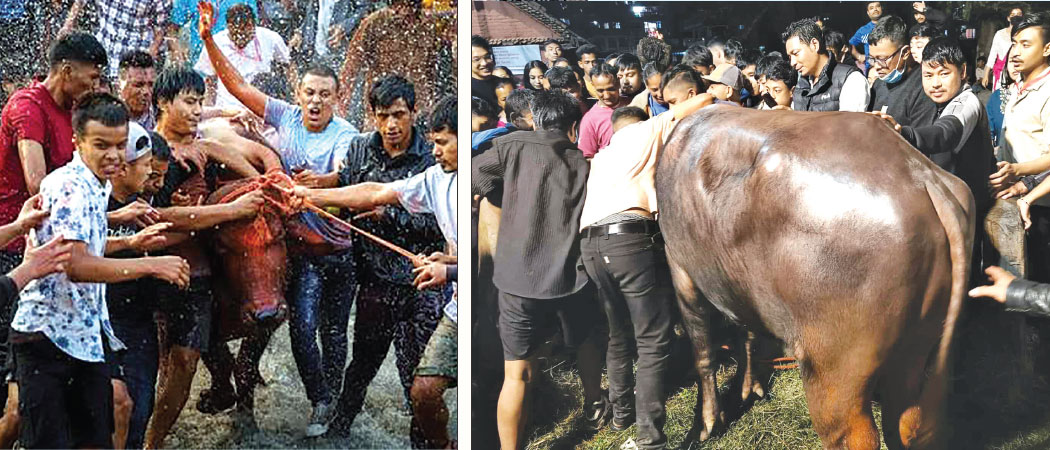
Each year, on the ninth day of Mohani Nakha (Dashain), a Khame (a robust male-buffalo) adorned with orange vermillion and intoxicated with alcohol, is released from the Navadurga Dya Chhen (Temple), which is in the eastern part of Bhaktapur city. The Khame is driven away by a huge crowd through various places, such as Sakolan, Dattatreya, Chyamha Singha, and finally Brahmayani. It is symbolically regarded as the demon Mahishasur. Upon reaching the Brahmayani River, the Khame is bathed, followed by special tantric rituals performed by Navadurga priests. At midnight, the Khame is slaughtered by severing its windpipe. This is the essence of Khame Jatra. The Khame offered to Navadurga must be entirely black, spotless, with unblemished horns, ears, and body, a perfectly round tail extending below the knees, and a body marked by seven chakras (hair whorls). The Khame must be brought to the Navadurga Dya Chhen between Shrawan Shukla Chaturdashi (Gathamuga Chahre) and Nag Panchami. If such a kind of male buffalo is not found on the day of Gathamuga Chahre, a rope is tied as the symbol of Khame in the peg in Navadurga Dya Chhen. Upon arrival, the Khame is tethered to a peg in the temple's southeastern room, where it remains until Mahanavami (the ninth day of Navaratri). The Khame is bathed daily, massaged with oil, and fed its favourite foods, including the jaand (homemade alcohol).
Navaratri begins on Ashwin Shukla Pratipada (Ghatasthapana). According to culture expert Om Dhaubadel, the nine Navadurga deities, such as Brahmayani, Maheshwari, Kumari, Bhadrakali, Barahi, Indrayani, Mahakali, Mahalakshmi, and Tripurasundari, are worshipped from Ghatasthapana to Nawami, respectively. On Nawami noon, the Khame is prepared for its final journey. It is given jaand, smeared with orange coloured vermillion, and ritually worshipped. Crowds gather at the premises of Dya Chhen to witness the Khame being released, tethered with a Brahmapas (long sacred rope).
The Khame is pulled and pushed through crowded routes, from Dya Chhen to Brahmayani, passing Sakolan, Dattatreya, Tachapal, Suryamadi, and Chyamha Singha. The journey is marked by chaotic scenes, with people pulling the rope from the front, pushing from behind, and vying to grab the Khame's horns, head, body, or tail. Upon reaching Sakolan, the Khame is said to hit its leg against a long stone placed there.
At Brahmayani, the Khame is bathed in the river before being tied to the first one of seven stone pegs. In the course of it, we can witness the delightful scene of sprinkling holy water on Khame's body as well as splashing among the festival-goers. At midnight, Mamsahuti Yagya (a sacrificial ritual) is performed by the priests.
The Khame's throat is gradually slit halfway, locating the main vein, causing a stream of blood to flow profusely. The blood is offered to appease Brahmayani Devi and the Navadurga deities, after which it is collected in a clay vessel which is called Bhail Koncha. Following the sacrifice, the Khama's head is separated and placed before the Yagya. When its body is skinned, the meat is distributed among the pantheon of Navadurga. Rest is given to the visitors as prasad (sacred food) the following day.
It is believed that if the prasad is taken into the house, the evils cannot harm the family members. On the day of Laxmi Puja, a piece of the prasad is kept in the fire as the incense to the goddess Laxmi. Actually, witnessing the process of sacrificing the Khame for ordinary people is not allowed. It is believed that anyone who sees the process will face death. Hence, the process is strictly prohibited to ordinary people.
The Khame sacrifice is linked to the tale of Mahishasur's slaying by Tripurasundari on Maha Navami. Mahishasur is believed to have entered the body of a Khame to escape the goddess, who eventually caught and killed him at Brahmayani. The annual sacrifice reenacts this mythological annecdote.
Progressive reforms
Cultural traditions symbolise old ways of life, often mixing faith and rituals. While their form may seem superstitious, their essence often promotes progress and enlightenment. In the Newar community, practices like Eehi exemplify progressive cultural values. In Eehi, a pre-menstrual ritual for Newar girls is performed. 'Ee' means time and 'Hi' means blood. Girls symbolically marry a Bel (wood apple), ensuring they are never considered widows even if they lose their husband in adulthood. This practice reflects a progressive approach to women’s independence.
Culture is a tool for refining human civilisation, emphasising beauty and compassion. If only the cruel traditions were reformed with modern values, it could be called culture in a real sense. While I do not argue for completely avoiding animals' slaughter, since eating meat is considered the food right of human society, it should be carried out humanely and discreetly.
Temples are architectural and cultural treasures meant to inspire peace and beauty. There should not be any incident that creates awe. Incorporating animal sacrifice as a celebrated ritual in these spaces demands thoughtful reform to preserve the sanctity of both our traditions and our humanity. While I know such types of opinion enrage many people, I sincerely hope the Khame Jatra and other such as the Gadi Mai procession in Bara and the festival in Khokana involving the sacrifice of a baby goat by biting it and men sucking blood of wounded male buffaloes undergo such progressive reforms, ensuring the beauty and relevance of the culture for future generations.