



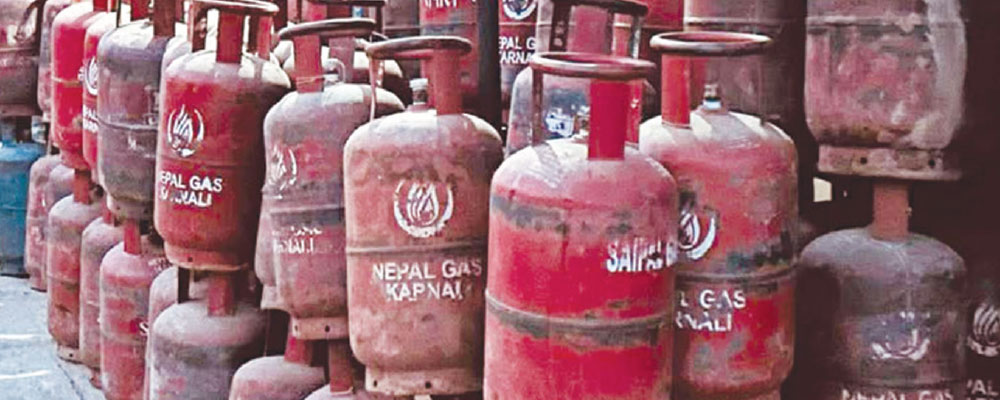
SATV, Kathmandu, Sept. 15: The supply of liquefied petroleum gas (LPG) in the Kathmandu Valley and surrounding areas is gradually improving with the use of alternative routes following the disruption of the main road at Krishnabhir.
According to the Nepal Oil Corporation (NOC), the country imported 52,737 tonnes of LPG during Bhadra (August 17 to September 13), equivalent to around 3.71 million cylinders.
LPG imports during Bhadra were higher than those recorded in the same month last year. The NOC imported around 3.35 million cylinders in Bhadra last year.
In the last three months since Asar, around 10.87 million LPG cylinders were imported.
Similarly, around 4.04 million cylinders imported and distributed in Saun and 3.14 million cylinders in Asar this year.
Likewise, 19,218 tonnes of LPG had been loaded from various refineries and bottling plants of the Indian Oil Corporation as of September 10.
Following the disruption of the main road due to a landslide at Krishnabhir, LPG is being refilled at bottling industries in the Tarai and transported to Kathmandu Valley and surrounding districts through alternative routes.
Around 399,529 cylinders transported through the Tribhuvan Highway and BP Highway were distributed to consumers between September 3 and 12, averaging nearly 40,000 cylinders a day, according to the NOC.
The corporation said distribution through the alternative routes is continuing.
The NOC has also prioritised LPG distribution to people affected by the devastating floods of August 26 in Rasuwa, Nuwakot and Dhading districts.
Meanwhile, the Ministry of Home Affairs and other concerned agencies are working to reopen the Krishnabhir road.
Trial traffic has resumed along the damaged section of Krishnabhir since Sunday evening as trail, while the authorities plan to formally reopen the road from September 17.
Once the road is reopened for regular traffic, transportation of LPG bullets will resume through the route, which is expected to further ease the supply situation.
LPG bottling industries supplying Kathmandu Valley will also be able to refill cylinders at their own facilities and distribute them to the market once regular transportation resumes.
A high-level coordination team has been formed to make LPG supply more effective, particularly in Kathmandu Valley.
The authorities are also coordinating with the Ministry of Home Affairs to intensify monitoring in areas where attempts are made to hoard cylinders or create artificial shortages.
The NOC said around 1,200 hoarded cylinders were found during recent monitoring and subsequently distributed to consumers. Sellers found involved in irregularities have also been penalised in accordance with the law.
Meanwhile, initiatives are underway to develop an online tracking system to make the sale and distribution of LPG cylinders more transparent, according to the NOC.
The NOC has urged consumers not to panic over the current supply situation, saying that measures are being taken to ensure regular distribution.
The NOC said the supply situation is expected to improve further once the main road is fully reopened.