




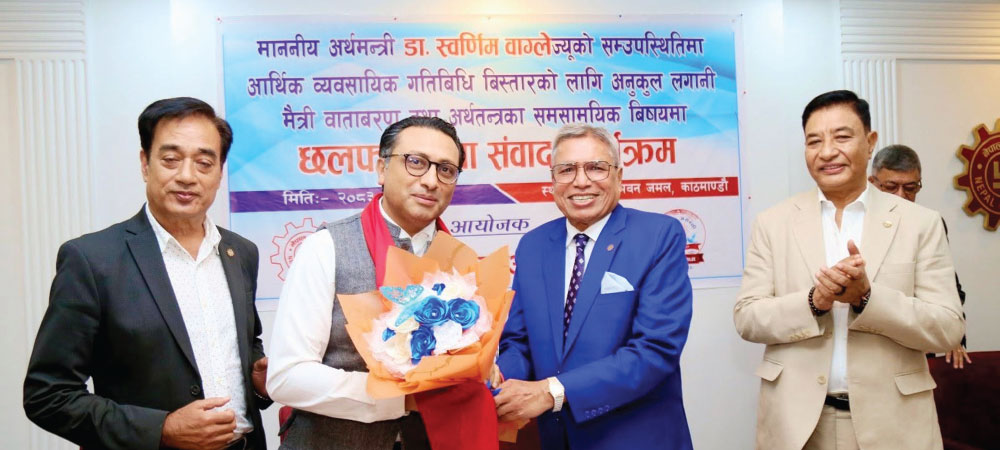
SATV, Kathmandu, Jun. 18 - Finance Minister Dr. Swarnim Wagle has said the government has adopted a strategy to accelerate economic reforms by creating a business-friendly environment for the private sector.
He made this remark during an interaction on creating a conducive investment climate for expanding economic and business activities and discussing contemporary economic issues, organised by the Nepal Chamber of Commerce on Wednesday.
On the occasion, business leaders and industrialists urged the government to address the challenges facing the private sector, emphasising the need for an investment-friendly environment to restore investor confidence.
Acknowledging the concerns and suggestions raised by the private sector, FM Dr. Wagle assured participants that the government would make every possible effort to address them. He said the government is committed to working in partnership with the private sector to steer the economy in a new direction.
The Finance Minister said the government is determined to resolve the policy and administrative bottlenecks that have hindered businesses in recent years and to revive entrepreneurial activities.
He added that priority has been given to streamlining the tax system, expanding digital services, and implementing investment-friendly policies.
He also highlighted measures announced in the budget, including tax exemptions on annual income of up to Rs. 1 million, efforts to make electricity-related taxation more consumer-friendly, and the implementation of education- and nutrition-focused programmes under corporate social responsibility initiatives.
He said that the government is moving toward a transparent, intermediary-free governance system.
NCC calls for investment-friendly climate
On the occasion, President of Nepal Chamber of Commerce Kamlesh Kumar Agrawal said that strengthening investor confidence is essential for reinforcing the country's economy.
While acknowledging that the budget for the upcoming fiscal year 2026/27 has sent positive signals, he stressed that its effective implementation would require close collaboration with the private sector.
President Agrawal said that the existing legal system related to money laundering has created unnecessary fear among businessmen and emphasised the need to ensure policy stability and investment security.
He also expressed concern over the government's decision to halt the registration of public transport vehicles, stating that it has adversely affected the automobile sector.
Agrawal stressed on the need for reforms in the stock market, implementation of a single International Securities Identification Number (ISIN) system, improvements in the tax regime, increased capital expenditure, and stronger coordination among regulatory agencies.
He also emphasised the importance of effective coordination between fiscal and monetary policies.
Former President of NCC Rajendra Malla pointed out the need to legalise the cultivation of non-narcotic marijuana.
He said that although non-resident Nepalis are encouraged to invest in Nepal, making the national identity card mandatory is not appropriate.
Suggesting that PAN card should be made mandatory while issuing citizenship, he said that the government should adopt a policy to create an environment that allows proper utilisation of natural resources.
Chair of the Chamber's Advisory Council and former President of NCC Rajesh Kazi Shrestha said that no country can achieve economic prosperity without respecting the private sector.
He said that businesses continue to face challenges due to traffic management, taxation policies, and administrative complexities.
Senior Vice President of NCC Deepak Kumar Malhotra said that the Money Laundering Prevention Act and laws relating to organised crime have created fear among entrepreneurs and investors.
He added that Nepal still lacks a truly investment-friendly environment and urged the government to give greater attention to the issue.