




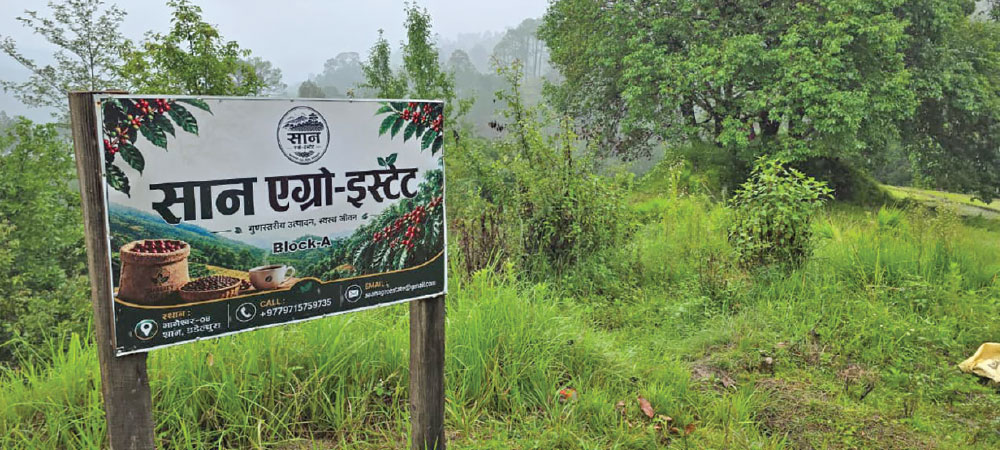
SATV, Kathmandu, July. 12 - A group of three youths has started commercial coffee farming for the first time in the district. They began commercial coffee cultivation by planting 2,000 coffee saplings on the slopes of Golai Village in Bhageshwor Rural Municipality-4.
The hillside, which had remained covered with bushes and grass for years, is now being transformed into a well-managed agricultural area. Commercial coffee farming has been introduced for the first time in Dadeldhura, a hilly district of Sudurpaschim Province.
Farmer Rajendra Bhandari said that Saan Agro Estate has created a new chapter in the agricultural history of the district by planting 2,000 Arabica coffee saplings. He said that this practice of three youths is not only a farming project, but also a story of their belief in the potential of their village and soil.
Generally, the dream of many Nepali youths at present is to work abroad. However, Dixit Bhandari, Nitin Chataut and Nischal Chataut have chosen a different path to do something in their own country.
According to Rajendra Bhandari, Dixit’s father, his son had saved Rs. 3 million with the aim of pursuing a Master’s degree in Thailand after completing his Bachelor’s degree in Business Studies in Kathmandu.
However, he suddenly changed his mind and decided to invest the amount in commercial farming instead of going abroad for further studies. They planted coffee saplings on barren land with the hope of creating opportunities in his home country. Two thousand high-quality Arabica coffee saplings were brought from Gulmi. “The land was prepared, shade management was arranged, organic manure was used, and irrigation facilities were ensured. Only after completing these preparations was the first commercial coffee plantation in Dadeldhura started,” said Bhandari. He said that around Rs. 1.5 million has been invested in the project so far.
According to farmer Bhandari, with the aim of diversifying agricultural production rather than depending on a single crop, the farm has also planted 50 mango, 25 litchi and 30 lemon saplings along with coffee. Shade management required for coffee cultivation has been arranged, and 20 quintals of vermicompost have been applied. He believes this will improve soil quality and support long-term productivity.
Coffee produced in Nepal has started gaining recognition in the international market due to its quality. Chief of the Agriculture Knowledge Centre, Dadeldhura, Narendra Paneru, said that areas located at an altitude of 1,000 to 1,600 metres above sea level are considered suitable for coffee cultivation.
As a large part of Dadeldhura lies within this altitude range, the climate, temperature and soil conditions of the district are favourable for Arabica coffee, he added. “Coffee farming is not a business that provides immediate returns,” he said. “The saplings planted today will start producing after around three years. However, a single plant can continue to provide regular production for nearly 25 years thereafter.”
Therefore, coffee is considered a long-term agricultural investment that can provide income for generations rather than a short-term venture. He said that Saan Agro Estate is laying the foundation with a vision for the future.
The Agriculture Knowledge Centre, Dadeldhura, has provided a 50 per cent subsidy, amounting to Rs. 100,000, for the purchase of coffee saplings. It has also supported the purchase of pipes, manure and a pit-digging machine.