




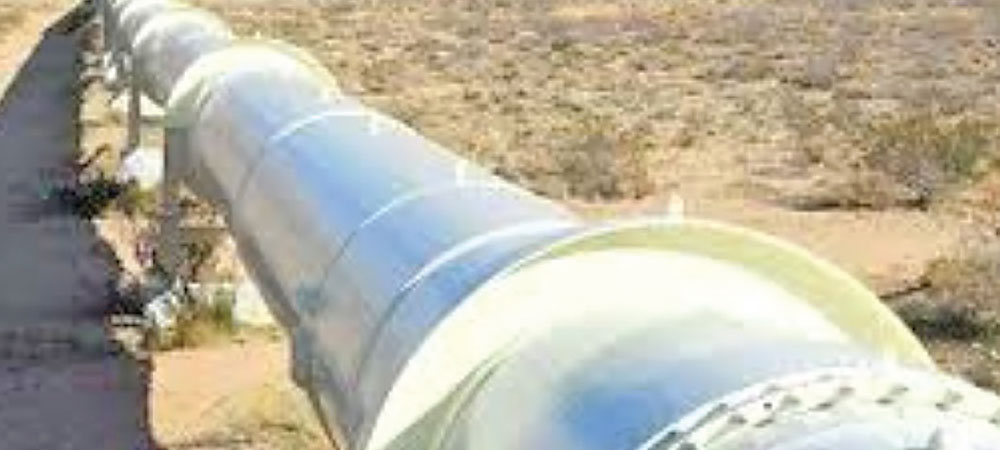
SATV, Kathmandu, Aug. 03 - Locals ha ve urged the authorities to minimise environmental damage during the construction of the Amlekhgunj-Lothar petroleum pipeline project, which passes through Makwanpur district.
The concerns were raised during a public hearing recently held in Hetauda on the Environmental Impact Assessment (EIA) of the Amlekhgunj-Chitwan (Lothar) petroleum pipeline extension and the proposed Greenfield Terminal at Lothar.
Elected representatives and local stakeholders called for the project to be implemented in a way that minimises its impact on drinking water sources, forests, wildlife and local communities.
The public hearing was organised by Nepal Oil Corporation Limited. Participants pointed to a lack of coordination among government agencies during project implementation and stressed the need for better institutional cooperation.
They noted that the pipeline route in Makwanpur passes through areas that include a national park, drinking water sources, community forests, a protected pangolin habitat and streams supporting native aquatic species.
They urged the authorities to ensure environmental conservation while minimising damage to public infrastructure and private property.
The project is an extension of the existing Raxaul-Amlekhgunj petroleum pipeline, which imports petroleum products from India. Under the expansion plan, a 60.241-kilometre pipeline will be constructed from Amlekhgunj to Lothar in Chitwan, along with a Greenfield Terminal at Lothar.
The pipeline will be built with financial support from India, while the Greenfield Terminal will be funded by Nepal Oil Corporation.
The Amlekhgunj-Lothar pipeline will begin at the Nepal Oil Corporation depot in Amlekhgunj, Jitpur Simara Sub-metropolitan City-21, Bara, and terminate at Lothar in Rapti Municipality-1, Chitwan.
In Makwanpur, the pipeline will pass by the Churiyamai Temple in Hetauda Sub-metropolitan City-15, continue through the Chure riverbed, cross the Karra and Rapti rivers, and follow the right-of-way along the East-West Highway before reaching Lothar.
Sukaram KC, ward chair of Hetauda Sub-metropolitan City-9, said the pipeline corridor overlaps with other proposed infrastructure projects, including a bypass road, high-voltage transmission line and railway, warning that inadequate inter-agency coordination could create future complications.
He urged the authorities to implement the project with minimal impact on eco-tourism.
Ward chair of Hetauda-19, Nararaj Subedi, stressed that the pipeline should not damage drinking water projects and called for efforts to preserve trees rather than cut them during construction.
Similarly, ward chair of Hetauda-11, Juna Dahal, said construction work should ensure that existing drinking water pipelines remain unaffected.
Project consultant engineer Niranjan Shrestha said no private land would be acquired for the pipeline.
He said the pipeline itself is estimated to cost Rs. 2.68 billion, while construction of the Greenfield Terminal will cost Rs. 6.13 billion, bringing the total project cost to Rs. 8.81 billion.
He said the underground pipeline will have a diameter of 10.75 inches and will be buried at a minimum depth of 1.2 metres.
Basanta Raj Gautam, forest officer at the Division Forest Office, Makwanpur, said adequate compensation should be ensured for any loss of forest resources caused by the project. Nepal Oil Corporation Deputy Director Ramhari Niraula said the project has a completion period of 54 months, of which 12 months have already passed.
He said all necessary safety measures would be adopted throughout both the construction and operational phases, using international standards and modern technology.
Deputy Manager Riniram Sharma said the pipeline-laying work is expected to be completed within 30 months of the start of construction.
He added that the existing Raxaul-Amlekhgunj pipeline has already helped save around Rs. 80-85 crore annually in transportation and related costs, and the extension is expected to ensure fuel quality while easing traffic congestion by reducing the number of fuel tankers on the roads.
The pipeline will pass through wards 14, 9, 10, 11, 12, 3 and 19 of Hetauda Sub-metropolitan City, as well as Wards 9, 8, 7 and 6 of Manahari Rural Municipality in Makwanpur before entering Lothar in Chitwan.