




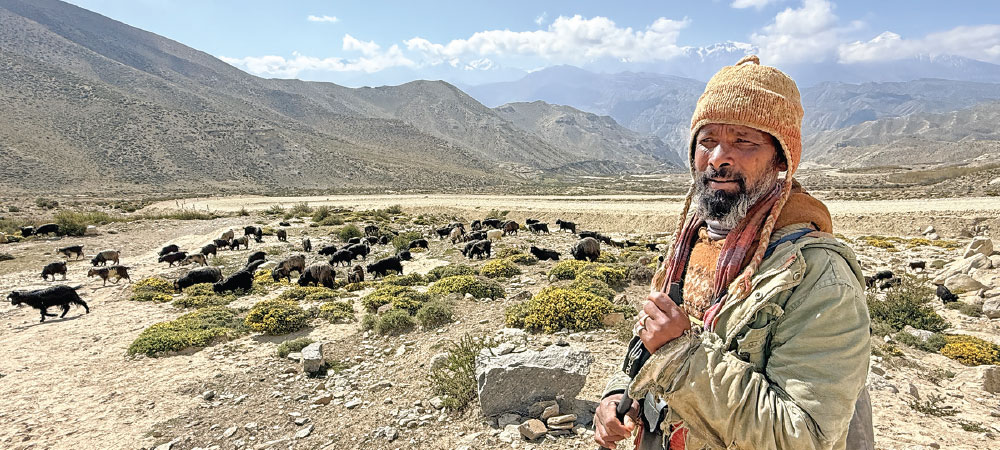
SATV, Kathmandu, Aug. 11 - When Keshab Pariyar left his home in Nisikhola Rural Municipality–6 of Baglung eight months ago, he had hoped to find work in a hotel or restaurant in Upper Mustang. Burdened by financial hardship and struggling to provide for his wife and four children, he travelled to Chhungar in Lo-Ghekar of Damodarkunda Rural Municipality-3 in search of a livelihood.
Instead, Pariyar found himself tending herds of Himalayan goats (Chyangras). A local livestock farmer offered him a monthly salary of Rs. 20,000, along with food and accommodation, persuading him to take up the demanding role of a shepherd. Since then, his days have been spent accompanying flocks of Chyangra goats across the high-altitude pastures of Upper Mustang.
Months of working in grazing lands at extreme elevations have taken a toll on his health. Repeated bouts of altitude-related illness have left him contemplating returning home, despite the financial necessity that brought him to Mustang in the first place. “After travelling to the high alpine pastures, I remained ill for a long time,” Pariyar said. “Some of my colleagues have already left, saying they plan to seek employment abroad.”
Like him, Akash Budha from Rolpa is also considering leaving the profession, saying the income does not justify the hardship involved. Over the past two years, an increasing number of shepherds have abandoned jobs in yak, mountain cattle and Chyangra farming, citing low benefits, health risks and harsh working conditions.
The growing exodus has created an acute labour shortage that is beginning to affect Mustang's livestock sector, where herders remain indispensable for managing sheep, goats, yaks, nak (female yaks) and cattle grazing in remote alpine pastures.
A profession few are willing to take up
Angyal Gurung, a Chyangra farmer from Chhoser in Lomanthang Rural Municipality–1, said finding shepherds has become one of the biggest challenges facing livestock farmers. “Even when we offer attractive salaries, it is difficult to recruit shepherds,” he said. “Many leave after making various excuses. The shortage of herders has become a major obstacle to expanding Chyangra farming according to our capacity.”
According to Gurung, shepherds working in grazing areas near the Chinese border, situated at elevations of around 4,700 metres above sea level, are paid more than Rs. 30,000 a month, in addition to food and lodging.
A flock of around 300 sheep and goats requires at least two shepherds, while some livestock owners in Mustang keep herds exceeding 3,000 animals, significantly increasing the demand for experienced workers. The labour shortage is not the only challenge confronting livestock farmers.
According to Dr. Lal Mani Aryal, Chief of the Agriculture and Livestock Development Office, Mustang, changing climatic conditions have further complicated traditional pastoral farming. He said declining snowfall due to climate change has reduced the availability of grass in alpine grazing areas, while attacks by wild animals continue to inflict substantial losses on farmers.
“Most livestock sheds are managed by workers who come from other districts,” Dr. Aryal said. “Because of the shortage of manpower, it has become difficult to encourage further investment and expansion in livestock farming.”
In Mustang's high Himalayan pastures, livestock are largely dependent on shepherds for daily management throughout the grazing season. The district's tourism industry may dominate public attention, but agriculture and livestock farming continue to rely heavily on migrant workers from across Nepal.
According to the Agriculture and Livestock Development Office, labourers regularly arrive from Myagdi, Parbat, Baglung, Rukum, Rolpa, Dolpa, Dhading and several districts in eastern Nepal to work in farms, hotels and livestock operations.
To improve working conditions, local, provincial and federal governments have supported the construction of environmentally friendly temporary shelters for shepherds. Seasonal workers are also provided with winter clothing and periodic health check-ups.
Sheep farming is concentrated mainly in Thasang and Gharapjhong rural municipalities, while sheep, Chyangra goat and yak farming remains the principal livestock activity in Baragung Muktichhetra, Lo-Ghekar Damodarkunda and Lhomanthang rural municipalities.
Despite these efforts, farmers warn that unless more people are willing to take up shepherding, one of Mustang's oldest mountain livelihoods could face an uncertain future.