




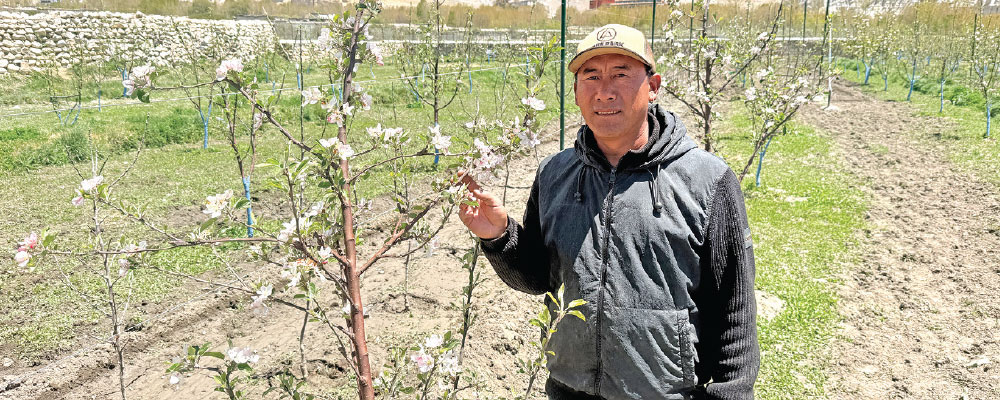
SATV, Kathmandu, Jun. 09 - Ward chairperson Tai Dhuntu Thakuri of Charang, of Lomanthang's Lo-Ghekar Damodarkunda Rural Municipality-1, has cultivated apples on 23 ropanis of land.
As apple farming has begun to flourish in Upper Mustang in recent years due to climate change, Thakuri has expanded his orchard this year by planting 300 high-density (hybrid) apple saplings, including on leased land in addition to his own property. Thakuri’s orchard has around 1,000 apple trees, including both hybrid and indigenous varieties.
Likewise, Chhewang Bista of Charang has nearly 4,000 apple trees spread across 50 ropanis of land. According to ward chairperson Thakuri, 30 out of 105 households of the village are engaged in apple farming. Thakuri said, “Those who previously practised traditional farming are now becoming attracted to apple cultivation, and the area under apple farming is expanding every year.”
Alongside his responsibilities as an elected representative, Thakuri said he has also been encouraging locals to take up apple farming through training programmes and by facilitating subsidies. There are around 13,000 apple trees in Charang. Farmers cultivate high-density varieties as well as Royal, Red, Richard, Golden and Fuji apples. Agricultural land across the rural municipality has increasingly been converted into apple orchards.
According to Thakuri, locals are particularly attracted to high-density apple varieties because they ripen quickly and are considered high quality in terms of size and appearance. As rising temperatures linked to climate change have pushed apple farming into Upper Mustang, farmers have started planting apple trees on land where barley, buckwheat and potatoes used to grow previously. Chairperson of Lo-Ghekar Damodarkunda Rural Municipality Lopsang Chompel Bista said the municipality has begun providing subsidies for saplings, agricultural tools and equipment.
He said, “As fruits previously grown in Lower Mustang have started growing in higher regions, we have prioritised support for apple farming.” He added that the municipality has introduced grants, machinery and equipment to encourage local people to engage in agriculture. In Ward No. 2, Ghyami village, local farmers have cultivated apples across around 950 ropanis of land.
Around 43 households initially planted apples collectively and individually on a trial basis. Following successful harvests and market sales, cultivation has expanded rapidly. Similarly, 26 households in Dhye village of Surkhang, Ward No. 2, have cultivated apples on 1,200 ropanis, Bista informed.
As water sources in the village have dried up due to climate change, even displaced locals have become active in apple farming after managing irrigation canals. Dhye village lies at an altitude of around 4,000 metres above sea level.
With apple farming now expanding into areas such as Tangye and Yara Ghara in Upper Mustang, the Temperate Horticulture Development Centre, Marpha, has also established a satellite agricultural farm in Ghyami village of Lo-Ghekar Damodarkunda Rural Municipality-2, according to centre chief Prakash Panta. As climate change has enabled apples traditionally grown in Lower Mustang’s Thasang, Gharapjhong and Varagung Muktichhetra rural municipalities to spread into higher regions, the centre has acquired 801 ropanis of land to establish facilities targeting farmers, including those in Lo Manthang Rural Municipality.
Production in Lower Mustang has declined due to reduced snowfall, which is essential for apple cultivation. The horticulture blocks in Mustang currently host 35 varieties of apple saplings.