




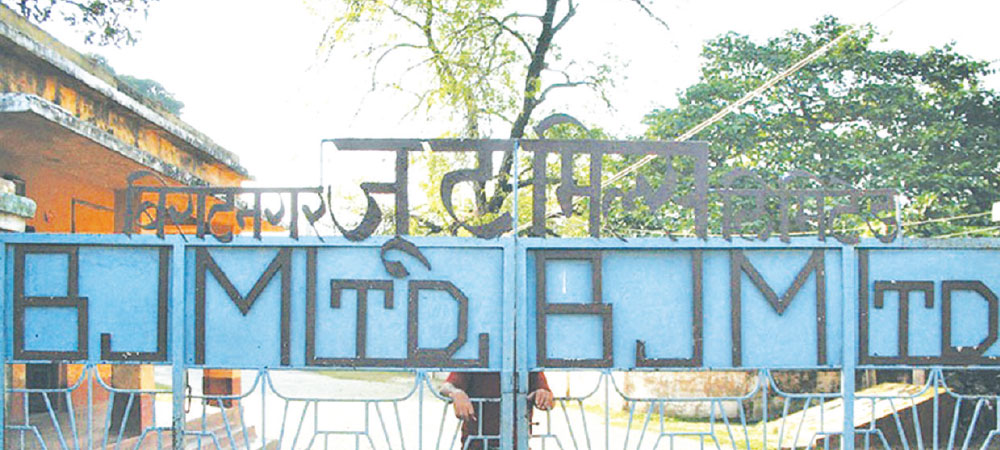
SATV, Kathmandu, Aug. 15 - Biratnagar Jute Mills, which gave rise to the Sunsari-Morang industrial corridor, was a Rana-era factory that helped usher in an industrial wave in Nepal. Established in 1936 (1993 BS), it is not only an important part of the country's industrial history but also became a centre from which democratic political awareness spread.
The jute mill is closely linked with key events in Nepal's democratic movement. The 1946 (2003 BS) movement for democracy and the establishment of Radio Prajatantra in 1949 (2006 BS) are both recorded in the country's history alongside the mill. Once providing employment to around 8,000 workers, the factory is now remembered more as a source of historical pride than as a functioning industrial enterprise.
Located in Biratnagar-15, Rani, the mill is now overgrown with weeds and vegetation, while its buildings and other structures continue to deteriorate. Some structures are collapsing, while others have already fallen into disrepair.
Nanda Lal Devkota, chairman of Biratnagar Jute Mills, said the government has now formed a study task force, which he believes could help find a solution for the mill. He argues that there is still a possibility of operating the factory.
However, he said the mill's condition from its past to the present must be assessed comprehensively, along with the investment required for its future operation.
Former chairman Rajendra Karki said that although efforts to preserve the mill's history are positive in principle, its operational condition has become extremely weak. However, he said, “If the government is willing, the mill's ownership and property can still be properly protected, even if restarting production is no longer feasible.” Karki resigned on May 2, 2026 (Baisakh 19), after which the board of directors appointed Devkota as chairman.
Although the mill has been unable to operate, successive boards of directors have continued to be formed. The jute mill has been in decline since 2046 BS and has been completely closed since 2013 (2070 BS). Several boards have been appointed since its closure, but its financial condition remains extremely weak.
A 2015 (2072 BS) assessment showed that the mill had total liabilities of Rs. 3.2 billion. During the tenure of then-chairman Nilhari Kafle, efforts were made to move the company forward in accordance with legal procedures, prompting a detailed assessment of its overall financial position.
At the time, records at the Office of the Company Registrar showed the mill as a public limited company, with the Government of Nepal holding a 46 per cent stake. According to that assessment, the mill still owed Rs. 1.5429 billion on a loan of Rs. 17.5 million taken from Nepal Bank in 1982 (2039 BS). It also owed Rs. 10.7 million on a Rs. 1 million loan from NIDC, while a Rs. 45 million loan taken from Udayapur Cement Industries Limited in 1994 (2051 BS) had risen to Rs. 85 million including interest. In addition, Rs. 53,000 worth of medicines purchased on credit from Nepal Drugs Limited in 1996 (2053 BS) remained unpaid.
Former chairman Karki said that the mill's net tax arrears dating back to 1979 (2036 BS), including penalties, fines and interest, had reached Rs. 145 million. In 2015 (2072 BS), the government at the time facilitated a settlement of the tax liabilities through the Tax Settlement Commission. Current chairman Devkota said the mill's latest financial position is still being verified. He said the government-formed task force would also examine all aspects of the mill.
Despite having assets, the mill has accumulated greater liabilities, and its proposed revival has repeatedly become a subject of political manoeuvring. According to the mill's financial records, the government had provided Rs. 1.0963 billion in concessional loans up to the 2009/2010 financial year. Including interest, the liability had risen to Rs. 1.7213 billion by 2015.
Similarly, a Rs. 10.44 million loan provided by the Asian Development Bank for modernisation had increased to Rs. 57.04 million a decade ago. A loan of Rs. 91.65 million raised through debentures had grown to Rs. 431.17 million, according to the 2015 report.
Whatever the mill's operational condition, records show that it owns around 69 bighas of land. Experts said government intervention is necessary to protect this valuable property.
Chairman Devkota said that five daily-wage security guards and two administrative employees are currently working at the mill. He said the authorities would decide what course to take only after completing a comprehensive assessment of its condition.
The factory had been running at a loss since 1993. In an attempt to revive it, the government leased the mill to Winsome International of Kolkata, India, for 25 years in 2012. However, the company terminated the agreement and withdrew after just one year and three months.
Before that, Arihant Multi Fibres had taken the mill on a five-year lease in 2002. Arihant also withdrew from the agreement in 2005.