




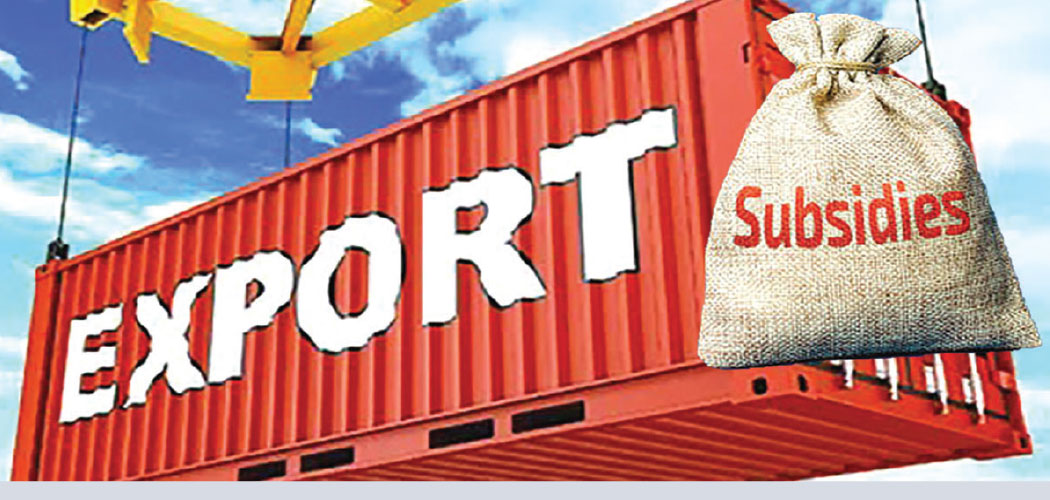
SATV, Kathmandu, Oct. 7- Nepal’s goods and services exports could increase by up to 112 per cent over five years if major constraints facing export sector and exporters are addressed, according to a new study.
The study titled Constraints and Enablers of Nepal’s Exports of Goods and Services, jointly released by the Asian Development Bank (ADB), Society of Economic Journalists Nepal (SEJON) and South Asia Watch on Trade, Economics and Environment (SAWTEE) on Tuesday, said Nepal needs to adopt a new growth model based on competitive businesses, exports and private investment.
The study shows that high borrowing costs have increased the cost of Nepali products. Taxes on imported raw materials and other inputs required for production have also made it difficult for Nepali products to compete in international markets. Weak logistics infrastructure and high transportation costs are also major barriers to exports, according to the study.
The report, however, noted that Nepal’s diaspora, duty-free market access, trade fairs, digitalisation and Nepal’s positive image abroad have helped exporters access foreign markets. It also highlighted growing hotel capacity, religious tourism and emerging activities as opportunities for expanding services exports.
It supports the preparation of ADB’s Country Partnership Strategy for Nepal (2025–2029) and the search for a new growth model. The report uses data and information available up to 31 August 2025. Speaking at the event, Finance Secretary Dr. Ghanshyam Upadhyay said that Nepal needs to make its export growth sustainable while boosting private-sector confidence and accelerating government capital expenditure to strengthen the economy.
He said that the country should move from a remittance-based development model towards one focused on private investment, export competitiveness and job creation. He said the government would benefit from the study and policy recommendations presented at the workshop and incorporate them into its day-to-day work and formulation of upcoming fiscal policies.
Arnaud Cauchois, ADB Country Director for Nepal, stressed the need for Nepal to move towards a competitive export-based development model to become a high-income country.
He said Nepal’s goods exports have remained sluggish, with the share of exports in gross domestic product (GDP) declining from 15.4 per cent in 2000 to 5 per cent in 2025.
He said Nepal needs to move beyond a remittance-based development model and focus on productivity growth, domestic private investment, foreign direct investment and competitive exports to become a high-income country.
Kshitiz Dahal, Senior Research Officer at SAWTEE, made a presentation based on the study.
The study states that Nepal’s exports are concentrated in a limited number of products and mainly in one major market. Between 2022 and 2024, around 71.9 per cent of Nepal’s average merchandise exports went to India. The annual average value was around USD 958.7 million.
The study interviewed representatives of 50 firms. Of them, 38 were exporters, while 45 firms completed a structured questionnaire.
Almost all firms said they faced various constraints. On average, the firms estimated that exports could increase by 112 percentage points over five years if these constraints were removed.
According to the study, access to finance is a major challenge. Around 84 per cent of surveyed firms identified it as a constraint, while 54 per cent considered it a major or serious constraint.
Interest rates were identified as the biggest problem, followed by fluctuations in interest rates and collateral requirements. Small and medium-sized firms are the most affected.
Logistics, trade infrastructure, availability of land at affordable prices and difficulties in importing production inputs were also identified as major problems. Firms exporting to markets other than India identified logistics and trade infrastructure as their major challenges.
The firms also identified limited government support, limited information about the impact of Nepal’s graduation from the least developed country (LDC) status, barriers in e-commerce and climate change as emerging risks.
Regarding the information technology sector, the study noted that global demand for digitally delivered services is increasing. Nepal’s IT service exports were estimated at around USD 515 million in 2022, which was 64.2 per cent higher than the previous year.
However, the study identified gaps in data protection, cybersecurity and intellectual property rights, the lack of an overall IT export policy, difficulties in obtaining foreign currency for software and other inputs, weak digital infrastructure and a shortage of skilled workers as major challenges.
A panel discussion on “Addressing Constraints and Utilising Opportunities in Nepal’s Goods and Services Exports, Merchandise Trade, IT Services and Tourism” was also held during the event.