




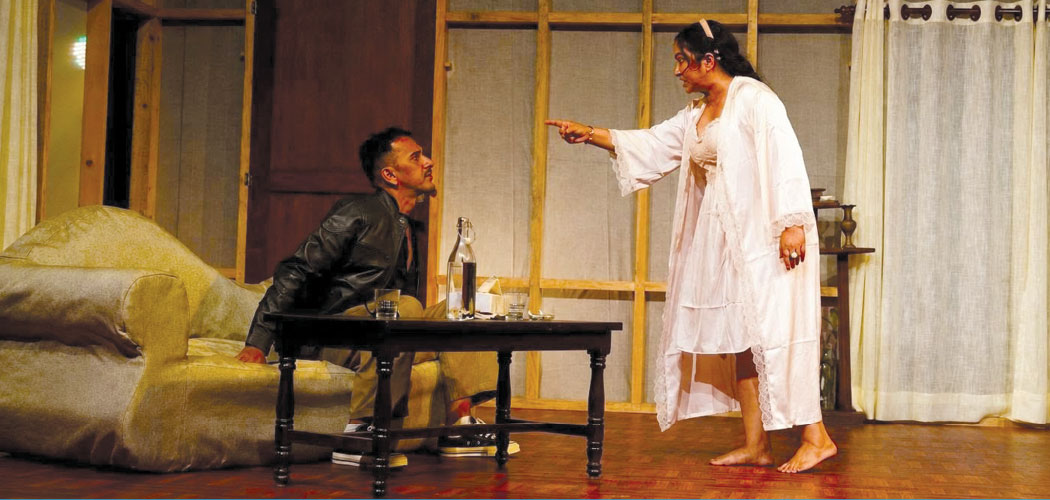
SATV, Kathmandu, Aug. 22: The popular play currently running at Shilpee Theatre in the capital, 'Miss Menuka: Ek Sambedansil Yaunkarmi', is a story of atrocities and hatred by the Pahade community against the Madhesi community. It is a Nepali adaptation of French author Jean-Paul Sartre's famous play 'The Respectful Prostitute.'
Translated from French into Nepali by Kalpana Ghimire Nurisson, the play was adapted to the Nepali context by Bhaskar Gautam. Sartre's original play is based on a real incident that occurred in 1931 in the southern state of Alabama, USA, widely known as the 'Scottsboro Boys' case. In the incident, an all-white court handed down harsh sentences to nine Black youths based on false rape allegations made by two white prostitutes. The themes raised in the play, such as racial discrimination, the abuse of power and authority, and the distortion of truth, remain equally relevant across the world and at any given time.
Renowned theatre actress Pabitra Khadka is the director of this play. In the Nepali adaptation, the main character is Menuka, a sex worker travelling by bus from Dharan to Kathmandu. During the journey, she witnesses wealthy youths from Kathmandu committing atrocities against two Madhesi youths. One of the Madhesi youths is shot dead. The culprit is a Member of Parliament's (MP) nephew. The MP’s son, Bibekjung Sharma, two police officers, and MP Jagannath Sharma pressure Menuka to sign a false document claiming that the two Madhesi youths raped her. Menuka's conscience tells her that the Madhesi youths are innocent. She even assures the victim, Arvind Paswan, that she will tell the truth to the police if necessary. However, influenced by the MP’s persuasive talking, she ends up signing the forged document. The murderer is released from prison.
The play is magnificent, and the actors have all excelled in their performances. In particular, Sarita Giri in the role of Menuka, Prabhakar Sharma as the cunning MP Jagannath Sharma, and Ghimire Yubaraj as the wicked youth Bibek Sharma deliver phenomenal performances. For an hour and a half, the play completely grips the collar of the audience.
The misuse of power and authority, a police force siding with power, and the discrimination against the Madhesi community evoke an anger in the audience strong enough to incite a movement.
However, the core question is: what is the play's perspective on a woman's conscience? It sends a message that women, even when they know the truth, are unable to make the right decision at a critical moment. Sartre's original play says the same thing. Are women really that weak?
Yet, a staged play or film is considered more of a director's creation than the author's. A director can make a convincing change without killing the soul of the play. 'Miss Menuka' could have been portrayed as telling the truth before court and giving justice to the suppressed. Furthermore, why did the two actors playing police officers in the Nepali context not wear the uniform of the Nepal Police? They looked more like American or French police officers than Nepali ones.
In the name of realism, are we becoming status-quoists? The question arises: can women not stand firmly for justice at critical moments? After watching the play, this question lingers in the minds of a sensitive audience.