




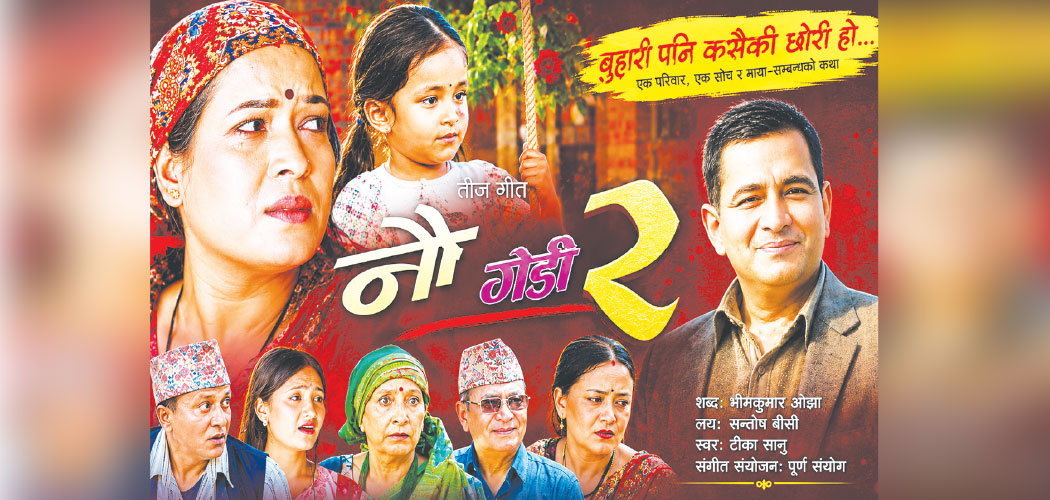
SATV, Kathmandu, Aug. 24 - Teej is not only a festival and an opportunity for entertainment in Nepali society, but also an important means for women to express their pain, suffering and social realities through songs. The Teej song ‘Nau Gedi-2’, created with this social reality in mind, has been released.
Featuring lyrics by former High Court judge and lyricist Bhim Kumar Ojha, music by singer-composer Santosh BC and vocals by singer Tika Sanu, the song explores the family pain, social discrimination and complex relationships that Nepali daughters-in-law often face. The song and its video have been released on Ojha’s own Bhim Kumar Ojha YouTube channel.
In the previously released ‘Nau Gedi-1’, the story of a daughter-in-law subjected to continuous mental torture by her mother-in-law, brother-in-law, sister-in-law and husband was presented. She found the strength to return to life through the love of her young daughter. ‘Nau Gedi-2’, which continues the same story, further portrays the daughter-in-law’s family pain and neglect. This time, however, the greatest force driving her forward is her unconditional love for her daughter.
The song raises questions about a social mentality that refuses to accept a daughter-in-law as a member of the family. It exposes the tendency to view a married woman merely as a ‘daughter-in-law’ and to inflict mental and domestic violence against her as normal in the name of tradition and culture.
Tika Sanu plays the daughter-in-law in the video. Her performance conveys pain, silent rebellion and a mother’s immense love for her child. Rather than relying on dialogue, she expresses her emotions through facial expressions and her eyes, making her performance one of the video’s most striking elements. Child artist Rubika Baskota plays her young daughter.
Santosh BC plays the husband. Through his portrayal of a stubborn and irresponsible man, he depicts the patriarchal mentality that prevents a husband from understanding his wife’s pain.
Similarly, Devi Ojha, lyricist Bhim Kumar Ojha's life partner, plays the mother-in-law. Her portrayal of a harsh mother-in-law who constantly torments her daughter-in-law is compelling. Through these characters, the video depicts the psychological pressure and domestic abuse that the daughter-in-law faces within her own home.
In contrast, lyricist Bhim Kumar Ojha himself plays an understanding and sympathetic father-in-law. His character conveys the message that not all members of a family share the same mindset. His role offers hope that humanity and compassion can survive even in a harsh family environment.
The video also makes social superstitions surrounding marriage an important part of the story. It portrays the mentality of blaming a newly married daughter-in-law for the death of her brother-in-law and placing responsibility for the tragedy on her. In doing so, the video questions an outdated social mindset of blaming a daughter-in-law for every misfortune.
Overall, ‘Nau Gedi-2’ is more than a Teej-themed song. The lyrics express pain, the music conveys sympathy, Tika Sanu’s voice evokes compassion, and the visuals reflect social reality.
By portraying the torture suffered by the daughter-in-law, particularly at the hands of her mother-in-law, sister-in-law and husband, the song raises an important question: How long will it take us to understand that a daughter-in-law is also someone’s daughter?
The most poignant aspect of the song is the way a mother, overwhelmed by suffering, ultimately draws strength from the love of her young daughter. That love gives her the courage to keep living even in the midst of pain.
Through its combination of lyrics, music, vocals and acting, ‘Nau Gedi-2’ seeks to move beyond the traditional entertainment associated with Teej songs and convey a message about women’s suffering, the power of motherhood and the importance of compassion within families. Alongside entertainment, the song and video encourage audiences to reflect on their own attitudes and behaviour within the family.