




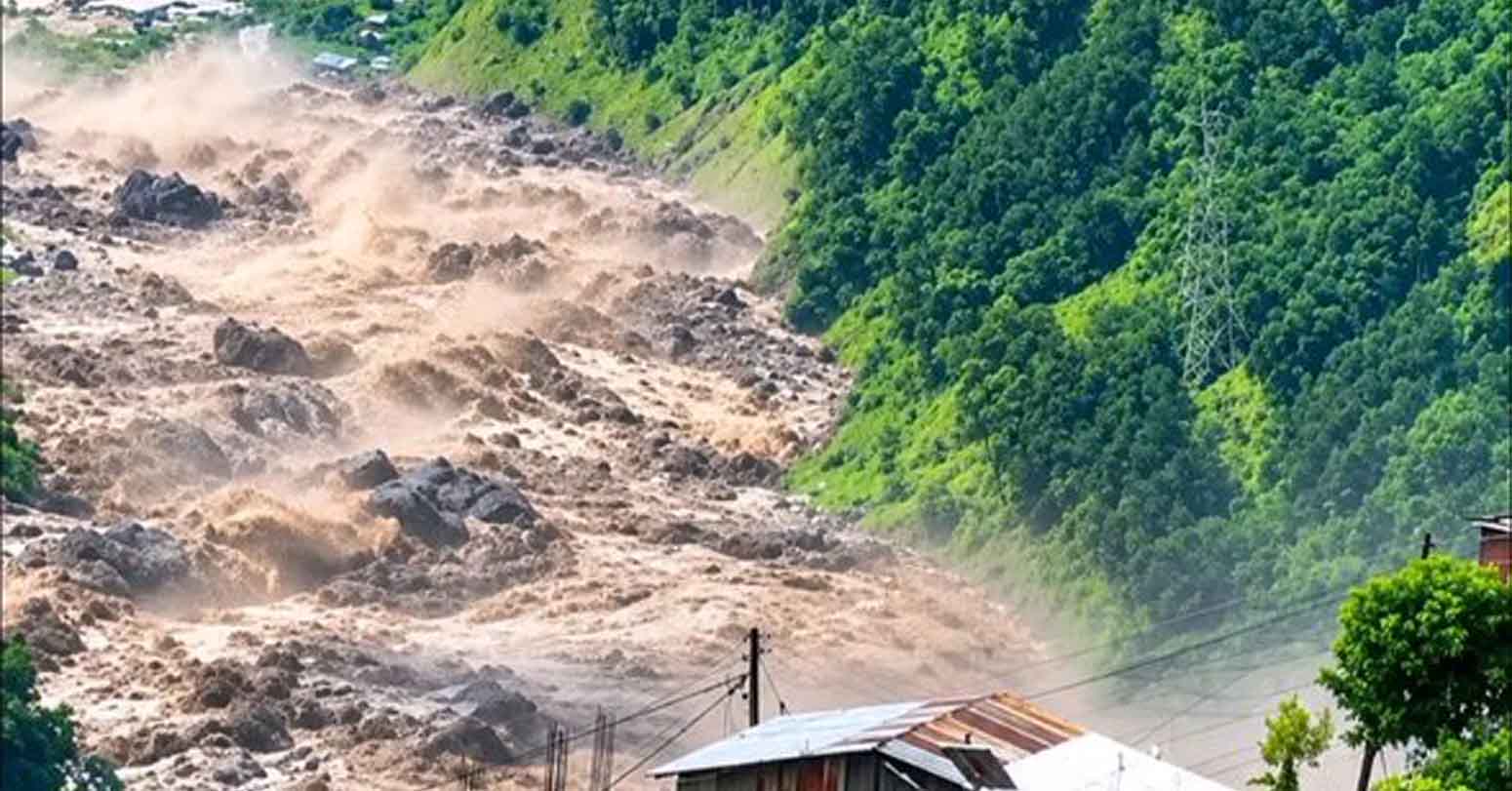
SATV, Kathmandu, Oct. 6- More than 40 days after a devastating flood tore through the Bhotekoshi, Trishuli and Narayani river systems, a government-formed panel tasked with determining what caused the disaster is still bogged down in a debate over what to call it.
Prime Minister Balendra Shah Highlighted the disaster at the United Nations General Assembly on September 25, describing it as a ‘Himalayan tsunami’ as Nepal sought to frame the floods as a climate-related catastrophe on the international stage. Foreign Minister Shisir Khanal had already argued at several international forums that Nepal should receive climate finance and compensation.
But the government has been slow to gather the scientific evidence needed to substantiate such claims. China began investigating the disaster the day after it struck, sending a study team to the affected area. Nepal, by contrast, has yet to reach the site where the ice-rock avalanche occurred.
After the home ministry and the National Disaster Risk Reduction and Management Authority showed little interest in leading the investigation, the Ministry of Energy, Water Resources and Irrigation finally formed a seven-member committee on September 18.
The panel, headed by water policy and governance expert Devesh Belbase, has been asked to determine how the August 26 flood occurred, assess the role of climate change, recommend ways to prevent or reduce the risk of similar disasters, and formally name the disaster. Its terms of reference also call for the collection of scientific evidence and supporting documentation.
So far, however, the committee appears to have spent considerable time debating its name.
“We have not even been able to reach the site because of a lack of resources,” said committee member Anil Pokharel. “But based on the evidence and documents we have collected, along with consultations with scientists around the world, we have reached our conclusions. We will submit the scientific findings and supporting evidence to the government within the two-month deadline.”
The committee has held virtual discussions with international scientists and repeatedly debated names proposed by its members. Suggestions have ranged from names put forward individually by committee members to those recommended by foreign scientists.
Pokharel has proposed “2026 Langtang Ice Rock Avalanche”, with the Nepali equivalent “2083 sal ko Langtang mahabipatti”. Another member, Rijan Bhakta Kayastha, argues that the event should be called a “glacial flood”, saying its nature appears to have been fundamentally different from the floods that typically occur during the monsoon. The issue is also being discussed with a wider group of government experts, he said.
Sources said Kathryn March, a retired Cornell University professor, has suggested that the disaster’s name should be linked to the Tamang language. The committee has yet to settle on any name.
Shah called the August 26 disaster a ‘Himalayan tsunami’ in his address to the UN General Assembly. The term, however, has not featured in the expert committee’s discussions so far. “‘Himalayan tsunami’ is not among the names currently being considered by the experts,” a committee source said. “Before finalising the report, we will consult the government, hear its views and put forward our recommendation.”
Nepal has been describing the August 26 disaster as a climate-change-driven catastrophe while seeking compensation internationally. To support such a claim, however, the government will need scientific evidence establishing the nature and origin of the flood, its causes and the extent to which climate change contributed to it.
The Bhotekoshi flood originated across the Nepal-China border in the Lhende area before entering Nepal through Rasuwagadhi. Yet no Nepali government team has been able to reach the disaster’s point of origin.
The main reason, according to Dharam Raj Uprety, executive chief of the National Disaster Risk Reduction and Management Authority, is a lack of funding. “We do not have sufficient funds,” Uprety said. “China has been providing us with the information we need. We will go there if necessary.”
Nepal has not traditionally followed a formal practice of naming major disasters, although some events have acquired names that have made them easier to identify in retrospect. The 1990 earthquake is widely remembered as the 1990 Great Earthquake, while the 2015 earthquake is known as the Gorkha earthquake.
Pokharel, a former executive chief of the disaster authority, said naming major disasters is an established international practice that helps preserve their memory and gives them a lasting historical identity. “There is a global practice of naming major disasters,” he said. “In Nepal too, local names have often become the names by which disasters are known nationally. It is a positive step that the government is seeking to give this disaster an official name.”
But giving the disaster a name is only part of the task, he said. Nepal also needs to ensure that the event becomes recognised internationally. “When the world talks about climate change, the images usually focus on melting ice and polar bears,” Pokharel said. “This time, we need not only to name the disaster but also to put it on the global map.”
He said Nepal should push for the Rasuwagadhi-Bhotekoshi disaster to become a reference point whenever the global impacts of climate change are discussed.