




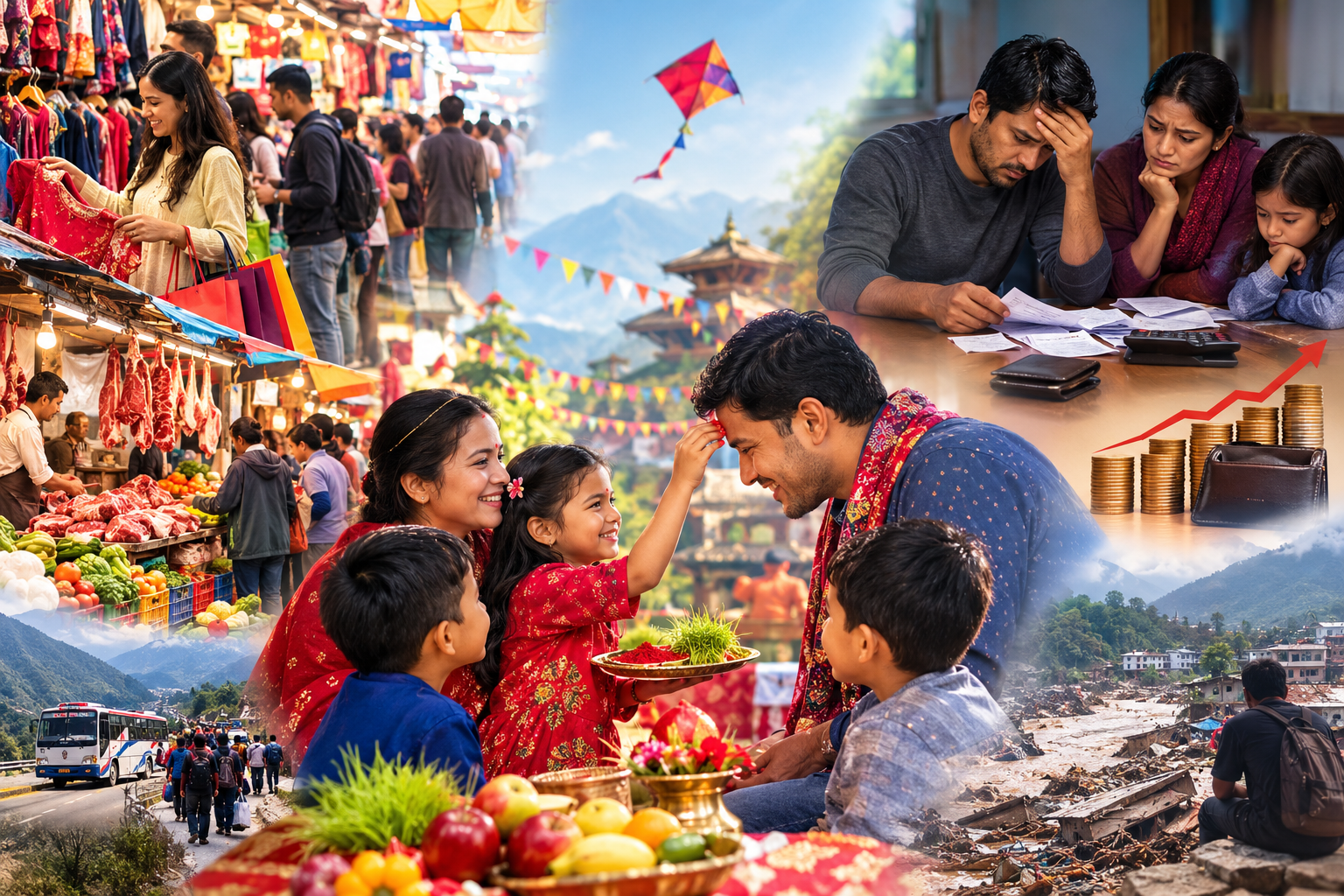
SATV,Kathmandu, October 18-Dashain has arrived, bringing a wave of activity across markets throughout Nepal. Clothing stores are crowded with shoppers looking for new outfits, meat shops are witnessing a surge in customers, and sales of fruits and groceries are picking up. Traditional bamboo swings have been erected in villages, kites are flying in the sky, and households have begun preparing jamara, the sacred barley shoots associated with the festival. While some people are rushing to return home, others are preparing to welcome relatives. Nepal’s biggest Hindu festival, Dashain, has brought excitement across the country.
Yet the festive atmosphere visible in the markets has not reached every household. For some, Dashain is an opportunity to buy new clothes, enjoy delicious meals and gather with family. For others, it is another period of anxiety over how to manage an entire year’s earnings. Alongside the joy of the festival, rising living costs, uncertain incomes and mounting expenses are putting increasing pressure on household budgets.
So, how much does an average Nepali family spend on Dashain?
For a typical four-member, middle-income household, expenses from festival preparations through the main tika celebrations, family visits and Kojagrat Purnima could reach between Rs 60,000 and Rs 85,000. This is an illustrative estimate based on possible household spending categories, not an official national average. Actual expenditure varies according to income, place of residence, travel requirements, shopping habits and the number of relatives a family visits.
Dashain expenses can broadly be divided into clothing, groceries, meat, transportation, religious supplies and cash gifts or dakshina. Individually, these may appear manageable. Added together, however, they can push a family’s festival budget from a few thousand rupees into the tens of thousands.
From New Clothes to the Kitchen, Expenses Keep Rising
Wearing new clothes during Dashain is deeply rooted in Nepali tradition. Families often buy outfits for their children, purchase clothes and shoes for other household members, and sometimes acquire essential household items. These purchases alone could cost between Rs 15,000 and Rs 25,000.
Food is another major attraction of the festival. Shopping for meat, rice, cooking oil, ghee, spices, fruits and sweets puts additional pressure on household budgets. The tradition of sharing meals with relatives and offering hospitality to guests further increases spending. A four-member household may need to allocate Rs 20,000 to Rs 30,000 for groceries and festive meals.
Transportation can also be a significant expense, particularly for families travelling from Kathmandu or other cities to their ancestral homes. Visiting relatives and travelling to receive tika from elders may add considerably to the total. Depending on the distance, mode of transport and number of family members travelling, transportation costs could range from Rs 10,000 to Rs 15,000.
Families must also budget for jamara, पूजा (religious) supplies, dakshina and other festival-related activities. These expenses could amount to another Rs 8,000 to Rs 15,000.
Adding these four major categories produces an estimated total of Rs 53,000 to Rs 85,000. The overall financial burden can be even greater when rent, loan instalments, school fees, healthcare and unexpected expenses are included.
Not every family spends this much. Households living in villages, relying on their own agricultural produce or limiting purchases of new clothes and travel may spend considerably less. By contrast, families living in cities who must travel long distances to return home may find Dashain particularly expensive.
Salaries Remain the Same, but Expenses Keep Growing
Understanding the financial pressure of Dashain requires more than looking at crowded markets. The crucial question is how household income compares with expenditure.
For someone earning Rs 30,000 a month, spending Rs 60,000 on Dashain would be equivalent to two months of gross salary. After paying for rent, food, children's education, healthcare and other daily necessities, setting aside enough money for the festival can be difficult.
Even a household earning Rs 50,000 a month may struggle to cover Dashain expenses. If little remains after regular monthly costs, the sudden arrival of festival-related spending can disrupt the family’s financial balance.
Shopping activity during Dashain must therefore be viewed in the context of household purchasing power. The availability of goods in shops does not mean everyone can afford them. Families who ask the price of new clothes and leave without buying them, reduce their meat purchases or postpone visits to relatives are also part of the festival’s reality.
Some Celebrate Freely, While Others Learn to Compromise
Wearing new clothes, preparing meat dishes and visiting elders to receive tika are deeply embedded in Nepali society. Yet for financially vulnerable families, these same traditions can sometimes become a source of emotional pressure.
Children notice when their friends wear new clothes. Before school holidays, they hear classmates discussing where they will travel and what they will buy. Social media is filled with family photographs, shopping trips and holiday outings. When parents cannot fulfil their children's wishes, they may feel uncomfortable or disappointed.
Some households cut back on essential expenses to buy new clothes for their children. Others borrow money from relatives, while some take out loans to celebrate the festival. For these families, the happiness of Dashain may last only a few days, but the burden of repaying borrowed money can continue for months.
Celebrating Dashain does not necessarily require new clothes or expensive meat dishes. However, social expectations and the tendency to compare oneself with others can drive up even modest household expenses. Families need to make decisions based on their actual financial circumstances rather than what others are buying or spending.
Festival Bonuses Bring Relief, but Daily-Wage Workers Face Greater Hardship
Some employees in the formal sector receive festival allowances or bonuses, providing additional support for Dashain preparations. However, the difference between receiving and not receiving such payments can significantly affect a household’s ability to manage festival expenses.
Daily-wage labourers, workers in the informal sector, small business owners and households dependent on irregular earnings face a different reality. Their incomes are uncertain. When work is available, they earn money; when it is not, meeting even basic daily expenses can become difficult.
For these families, preparing for Dashain is not simply about additional shopping. It is also about figuring out how to cover regular expenses while celebrating the festival. Rent, groceries, medicines and children's education must still be paid for.
Consequently, the festive atmosphere visible in the markets does not necessarily reflect the economic circumstances of the people celebrating—or struggling to celebrate—the festival.
Festival Expenses Add to the Suffering of Flood and Landslide Victims
Floods and landslides in the lead-up to Dashain have disrupted the lives of many families this year. Some have lost their homes, others have seen their farmland swept away, and many have suffered damage to their businesses. Damage to roads and bridges has also created challenges for transportation and the movement of supplies.
For these households, the immediate priorities are not new clothes or elaborate meals, but safe shelter, food, medicine and the restoration of normal life. Families whose homes have been destroyed may need to preserve whatever money they have for rebuilding and rehabilitation rather than festival celebrations.
Even households not directly affected by disasters may face the risk of more expensive travel when roads are blocked. Higher transportation and freight costs can also put pressure on the prices of goods. However, it would be premature to conclude that floods and landslides have raised the prices of all commodities without supporting price data. Assessing the actual impact requires comparisons of market prices, transportation costs and supply conditions.
As people celebrate Dashain, remembering families affected by disasters is equally important. The festival carries a different meaning for those who have lost their homes, livelihoods or loved ones. Some may have to spend this year's Dashain waiting for life to return to normal.
Let the Joy of Dashain Not Become a Burden of Debt
Spending money during Dashain is natural. Bringing happiness to family members, meeting relatives and preserving traditions are important aspects of life. However, spending beyond one’s financial capacity can create problems in the months that follow.
Setting aside a fixed portion of income for the festival, distinguishing essential purchases from unnecessary ones, preparing a shopping list in advance and avoiding debt for showy spending can help reduce financial pressure. Open discussions about household finances can also help families control unnecessary expenditure.
Festival spending should not be viewed solely as a matter of individual financial discipline. Income levels, job security, market prices and the availability of social protection all influence a household’s ability to celebrate. Controlling inflation, creating employment opportunities and ensuring effective post-disaster rehabilitation are therefore equally important.
The true happiness of Dashain is not limited to expensive clothes, lavish feasts or costly gifts. Being able to live safely and peacefully with family, seeing smiles on children's faces and celebrating without the anxiety of debt are equally valuable.
The crowds in the markets do not prove that prosperity has reached every household in the country. Alongside those shopping for the festival are families quietly cutting back on expenses. Their silence is also part of the reality behind the festive bustle.
Ultimately, Dashain is a festival shared by all, but economic circumstances are not shared equally. For some, it is an opportunity to spread happiness; for others, it is a challenge to balance the household budget. For families who have lost their homes and livelihoods, it may be a time to wipe away tears and remember what they have lost.
The festive atmosphere must therefore be measured not only by the crowds in the markets, but also by the condition of ordinary households—their kitchens, their pockets and their state of mind.
The tika of Dashain may reach everyone's forehead, but not everyone has the financial security to celebrate it with peace of mind.