




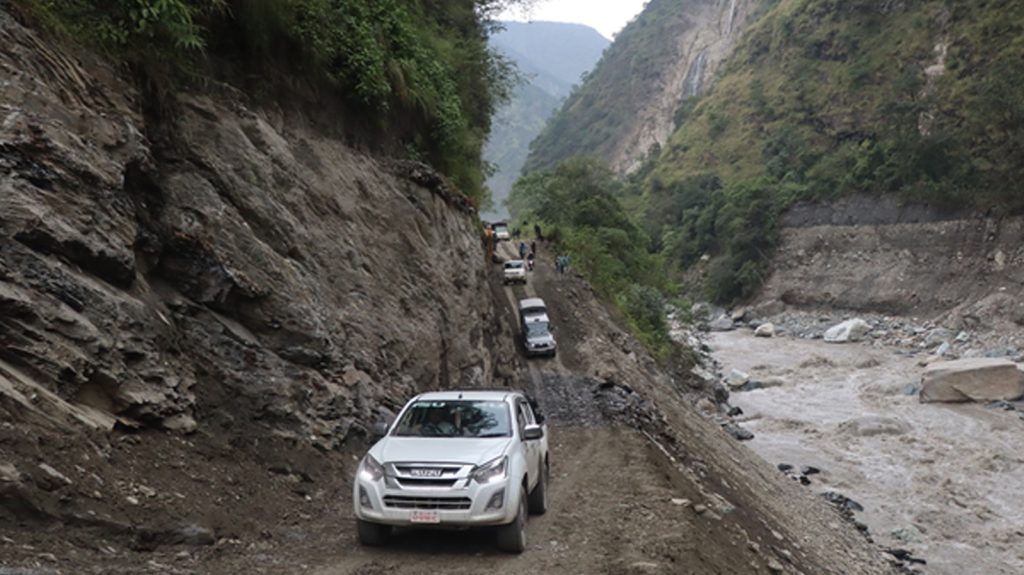
SATV, Kathmandu., October 9- Repair work on the Beni–Jomsom–Korala road, which connects to the Korala border crossing with China, has reached its final stage. However, challenges remain in ensuring regular, smooth, and safe transportation along the route.
The 202-kilometer Beni–Jomsom–Korala road, part of the Kaligandaki Corridor connecting China and India, runs from Maldhunga in Parbat district through Myagdi to the Korala border point in Mustang. The road was severely damaged by floods and landslides between September 24 and 27 (Ashoj 8–11).
Landslides occurred at 50 locations, while 10 sections of the road were washed away by erosion from the Kaligandaki River. Repair work has now reached its final stage.
Access roads at Kunauta Cliff in Raghuganga Rural Municipality–2, Myagdi, and the bridge at Pokharebagar in Annapurna Rural Municipality have been restored. Essential vehicles were able to cross these sections on Thursday evening. Reconstructing the road at Kunauta and the bridge approach at Pokharebagar, both washed away by the Kaligandaki floods, had posed significant challenges.
Tejaswi Sharma, chief of the Beni–Jomsom–Korala Road Project, said that the road currently allows one-way movement only for vehicles transporting fuel, ambulances, road construction equipment, electricity and telecommunications equipment, and relief supplies.
“Although the initial repair work has been completed, further work remains, including clearing landslide debris, filling eroded and sunken sections, levelling the road, and constructing cross-drainage structures,” he said.
“Operating traffic under the current conditions could lead to congestion and accidents. We have therefore planned to complete the repairs by Sunday and reopen the road to traffic from the following Monday.”
The areas most severely affected by river erosion and landslides include Kerabari, Lamabagar, Tilkenichaur, Rahupare, Sirubari, Kunauta, Mahabhir, Bhirkate, Dhirchang, Ratopani, Tatopani, Sukebagar, Khambhitta, and Khahare Khola.
Narendra Subedi, chief of the Federal Road Supervision Office in Pokhara, said that more than 20 kilometres of the 33-kilometre section of the road in Myagdi had suffered extensive damage. Blacktopping work had recently been completed on parts of this section, while concrete paving was underway in landslide-affected areas.
“Because Korala is currently the only operational border crossing with China, the government has given the road high priority and is preparing to restore traffic within two weeks of the disruption. However, restoring the road to its previous condition will require substantial investment and infrastructure development,” he said.
Subedi estimated that the road had sustained damage worth approximately Rs 900 million and that an additional budget of around Rs 3 billion would be required to reconstruct it according to a new design.
Subedi, who was also the founding chief of the Beni–Jomsom–Korala Road Project, said the recent floods had caused the most extensive damage since the project began.
According to him, several factors contributed to the unprecedented destruction, including heavy rainfall, damage to feeder roads, muck and debris dumped along the riverbanks by hydropower projects, weak geological conditions, the formation of new landslides, and rising flood levels in tributary rivers. These factors increased the volume of floodwater in the Kaligandaki River, resulting in extensive damage.
Ganesh Gaire, Chief District Officer of Myagdi, said preparations were underway to manage the challenges expected from cargo transportation to and from the Korala border, exports of apples and potatoes from Mustang, the tourist season, and increased domestic traffic during major festivals such as Dashain and Tihar.
More than 500 containers carrying goods imported through the Korala border for the Dashain festival have been stranded at various locations in Mustang and Myagdi while awaiting clearance to proceed to their destinations.
“We conducted an on-site inspection on Thursday with elected representatives and provincial-level security officials to determine traffic priorities for essential services, freight vehicles, domestic transport, and tourist vehicles,” Gaire said.
He added that discussions had also been held on deploying security personnel at narrow and hazardous sections of the road to prevent traffic congestion.
Gaire urged tourists planning to visit the region to postpone their trips for a few days until road conditions improve. He said priority would need to be given to essential services, domestic transportation, cargo containers, and vehicles transporting apples and potatoes to markets.
A team of officials inspected the road to assess preparations for reopening. The team included Gandaki Province Assembly member Resham Jugjali; acting chief of the District Coordination Committee, Dil Kumari Khatri; Chief District Officer Gaire; Federal Road Supervision Office chief Subedi; Major General Bholanath Thapa, commander of the Nepali Army’s Western Division; Deputy Inspector General Dipendra Gharti Chhetri, chief of Gandaki Province Police; Dipendra Shah, chief of the Armed Police Force’s No. 4 Muktinath Brigade; Myagdi Deputy Superintendent of Police Rajan Karki; and other district-level security officials.
According to Chief District Officer Gaire, a joint meeting of the District Security Committees of Myagdi and Mustang was scheduled for Friday morning to discuss arrangements and prepare an action plan for the orderly resumption of traffic along the Beni–Jomsom–Korala road.