




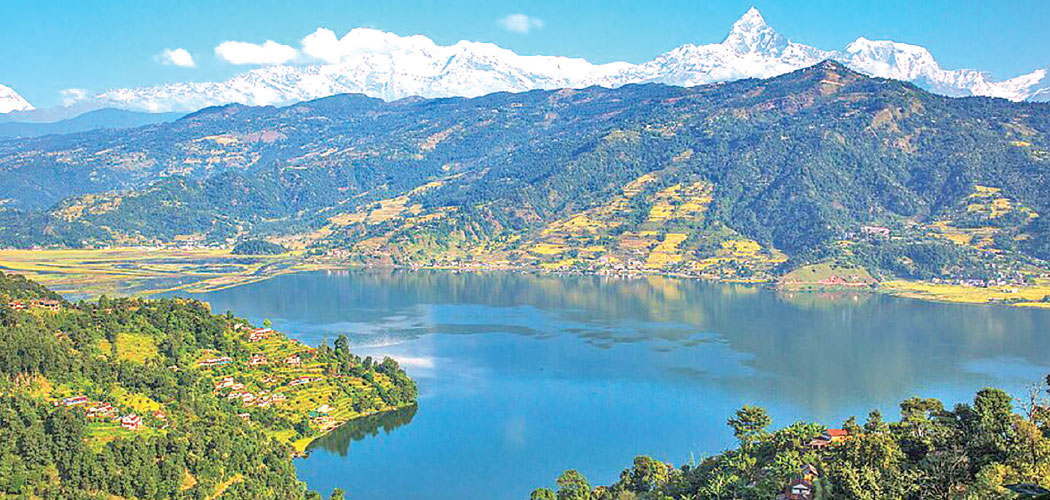
SATV, Kathmandu, May. 09 - “Was this lake formed from melted snow from those Himalayas?” asked Astika Pokharel, who was visiting Phewa Lake for the first time, to a boatman. “And where does the lake water go?”
The boatman explained that the lake is formed by the waters of streams such as Harpan, originating from Panchase, along with Buloudi and Phirke streams of Pokhara, as well as several springs and rivulets.
He further told her that electricity is generated from the excess water flowing out through the lake’s dam, and that the same water emerges underground as Patale Chhango waterfall. Hearing this, the young visitor was astonished.
Like her, many people assume that the lake is fed by water flowing directly from the reflected peaks of Machhapuchhre, Annapurna and other Himalayan mountains. At a time when preparations are under way to free Phewa Lake, the main attraction of tourism capital Pokhara, from encroachment, concerns are also growing about its future.
The lake, which has shrunk by half over the past six decades due to both natural process and human encroachment, cannot be preserved without protecting its watershed area.
Phewa’s watershed area is estimated to cover 123 square kilometres. A protected-area watershed plan prepared by the Integrated Watershed Management Centre recommends clearly identifying the watershed boundary and halting harmful activities taking place there.
Watershed Management Officer Amar Adhikari said, “It is essential to control floods, landslides and soil erosion in the watershed area.”
At the same time, rapid land plotting in the Phewa and the construction of hotels and resorts by cutting hillsides within the watershed are causing the lake to shrink.
Trilochan Parajuli, 91, a local of Thulakhet in Pokhara-23, recalls seeing the lake extend as far as the edge of Pame during his childhood.
“We used to take a boat from Chankhapur Ghat and get off at Hallan Chowk,” he said. “The boatman used to charge one suka, and when we were thirsty, we would scoop up and drink the lake water with our hands.”
He said he is sad that the lake has now become polluted and much smaller.
The Supreme Court in its verdict in 2075 BS, ordered that a 65-metre area from the lake shore be cleared and turned into greenery and also directed that the watershed area be protected.
The court also instructed that check dams be constructed within three years on the Harpan and Phirke streams flowing into Phewa in order to stop soil, rubbish and sludge from entering the lake, and that standards set for buildings and other structures within the watershed area. The verdict further stated “If additional decisions are required for conservation, the Council of Ministers shall make them.”
Even seven years after the ruling, neither construction standards for the watershed area have been established, nor has the 65-metre zone around the lake been cleared.
Following the formation of the government under Balendra Shah, there has been renewed hope that Phewa Lake will become free from encroachment and that conservation-friendly activities will be promoted in the watershed area. The government’s hundred-point governance reform agenda includes a commitment to remove structures encroaching upon Phewa within three months.
Prime Minister Shah has shown interest in the lake’s current condition. A task force formed by the Ministry of Land Reform has already studied the lake’s land area and submitted its report to the government.
Pokhara Metropolitan City Mayor Dhanraj Acharya said the Prime Minister’s concern has been encouraging and expressed hope that Phewa’s appearance will now be transformed.
“We believe the federal government will complete the necessary work on time. Determining and providing compensation is the responsibility of the federal government,” he said.
It is estimated that compensating the approximately 2,400 ropanis of land falling within the 65-metre zone at the government rate would cost around Rs. 10 billion, while compensation at market value could cost between Rs. 40 and 50 billion.
Mayor Acharya hopes that the upcoming budget will allocate compensation funds and support the clearing and beautification of the lake area.
Rights activist Ram Bahadur Poudel stresses that the lake must be saved, even if affected residents are compensated with replacement land or market-value payments.
“The lake is the reason Lakeside exists and why lake-based businesses thrive,” he said. “All three levels of government must implement the court order and locals must also cooperate.”
Advocate Khagendra Subedi believes that implementing the Supreme Court verdict and beautifying the lake are entirely possible. It was on the basis of a writ petition filed by Subedi that the Supreme Court delivered its historic verdict concerning Phewa.
Subedi said, “Influential business people may use locals as shields for their interests. However, if the government has the willpower, implementing the verdict is not impossible.”
Some studies suggest that if the lake continues to fill with sediment at the current rate, it could disappear within next hundred years.
The Jalari fishing community, which lives by the lake and depends on fishing for its livelihood, is also hopeful about the current government.
“Jalari people cannot imagine surviving without the lake and fish,” said Jalari leader Gyan Bahadur Jalari.
If the regulation is fully enforced, this community could become homeless. At present, more than five hundred structures stand within the designated boundary.
Unregulated construction, waste and sludge flowing in from streams, and reckless exploitation of land in the watershed area are all shortening the lifespan of Phewa Lake.