




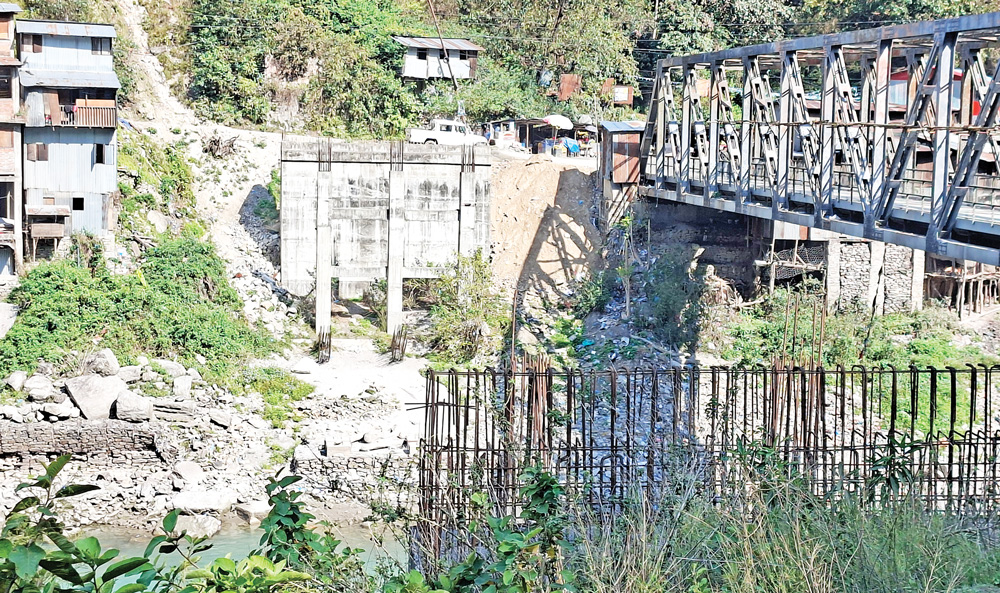
SATV, Kathmandu, April. 07 - The bridge over the Tamakoshi River, located on the main route connecting Charikot-Dolakha’s major commercial hub and the tourist destination of Jiri with Ramechhap, has remained incomplete for the past nine years. The project has become a symbol of government neglect and contractor negligence, lying abandoned for years.
Although the old steel truss bridge, constructed in 1982, has already exceeded its technical lifespan, instead of bringing the new bridge into operation, authorities have begun cosmetic repairs on the deteriorating structure. This has sparked dissatisfaction among locals.
Ignoring the fact that the decades-old bridge has lost its load-bearing capacity, the Bridge Division has started repainting it. Locals said this was an attempt to cover up government delays. Santosh Pokharel, a local, stated that repainting the bridge was merely a way to mask inefficiency.
A contract for the construction of a new concrete bridge was signed with Nilgiri-National JV on August 24, 2016, with a target to complete the project within two years. However, even after nearly nine years since construction began, the 75-metre-long RCC arch bridge remains unfinished.
The project, estimated to cost around Rs. 100 million, has no clear completion timeline due to contractor delays and weak government oversight.
Although initial construction work had begun, the contractor abandoned the project midway, leaving local residents’ hopes of a fully operational new bridge unfulfilled. Meanwhile, the old Tamakoshi bridge is in an extremely dangerous condition. Having borne traffic for 43 years, its iron joints have weakened, and the bridge shakes significantly when heavy vehicles pass over it.
The situation has drawn sharp criticism on social media, with many calling it both risky and questionable that authorities are attempting to make the old bridge look new with paint instead of ensuring the timely completion of the new one.
Locals argued that repainting would not extend the bridge’s lifespan and would only conceal the increasing risk of accidents. They labeled the move as a misuse of public funds.
With the new bridge still non-operational, hundreds of vehicles and thousands of passengers are forced to risk their lives every day while crossing the old bridge. This single deteriorating structure remains the only transport link connecting Charikot, Jiri, and neighboring Ramechhap district, leaving drivers and passengers in constant fear.
Despite repeated warnings and protests, the inability to act against the contractor and complete the project has raised serious questions about the effectiveness of local authorities and elected representatives. Rather than deflecting the issue through cosmetic repairs, making the new bridge operational as soon as possible appears to be the only viable solution.
Regarding the delay in the Tamakoshi bridge construction and ongoing maintenance work, Ratna Laxmi Bajracharya, Chief of the Bridge Sector Office in Kathmandu, said that progress had stalled due to the contractor’s negligence.
According to her, representatives of Nilgiri National JV are currently out of contact and have not returned to the project site, bringing the situation close to contract termination.
She stated that the office had set a deadline until mid-May for the contractor to resume work by installing a rig machine at the site. If work does not begin within this timeframe, the contract will be formally terminated by mid-June.
Bajracharya also informed that around Rs. 25 million has been allocated for the maintenance and repainting of the existing bridges over both the Sunkoshi and Tamakoshi rivers, including the replacement of structural members.
Although the contractor has verbally committed to resuming work, no tangible progress has been observed, and preparations to terminate the contract are now in their final stage.